
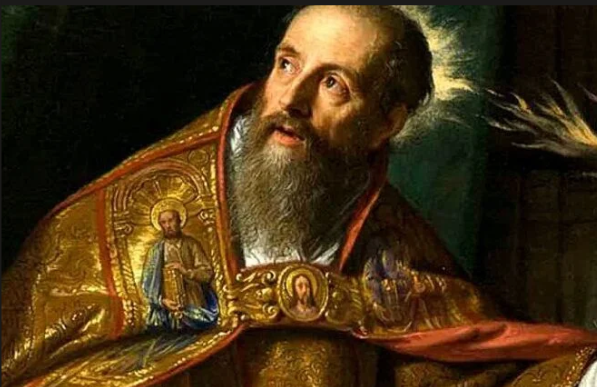
Few Christian thinkers have left a deeper mark on Western Christianity than Saint Augustine of Hippo. He was a theologian, philosopher, bishop, preacher, writer, and spiritual seeker whose influence reaches across nearly sixteen centuries. His story is remarkable because it did not begin with immediate holiness. He struggled, questioned, and searched. He pursued intellectual truth, felt the pull of ambition, wrestled with sexual desire, and lived with uncertainty. He followed philosophical systems that eventually failed to satisfy him, and for many years he resisted the Christian faith of his mother.
Then came conversion. In one of the most famous spiritual moments in Christian literature, Augustine describes hearing a child’s voice saying, “Take and read.” He opened the Scriptures, and the words he found became the turning point of his life. The man who had spent years searching for truth finally surrendered himself to Christ.
Augustine became bishop of Hippo Regius, a city in Roman North Africa, and one of the most influential Christian theologians of late antiquity. His writings, including Confessions, The City of God, On Christian Doctrine, On the Trinity, and hundreds of sermons and letters, have shaped Catholic theology, Christian philosophy, spirituality, political thought, biblical interpretation, and Western intellectual history. The Catholic Church recognizes him as a Doctor of the Church, and his feast is celebrated on 28 August.
Yet his importance cannot be reduced to books or titles. His story is deeply personal. It is the story of a man who looked outside himself for years before discovering that the deepest hunger of the human heart cannot be satisfied by ambition, pleasure, wealth, or intellectual achievement. His famous prayer captures the theme of his journey:
“Our hearts are restless until they rest in you.”
That sentence endures because it describes something many people still experience. The desire for meaning is rarely satisfied by success alone. We search, achieve, acquire, and become recognized, and still something inside asks: is this all there is? Augustine spent much of his life asking that question, and his answer became one of Christianity’s most enduring testimonies.
Historical Background and Early Life
Birth in North Africa
Augustine was born on 13 November 354 in Thagaste, a town in Roman North Africa now associated with Souk Ahras in Algeria. His full Latin name was Aurelius Augustinus. The world he was born into was very different from the Christian Europe that would later claim him as a foundational thinker. North Africa was part of the Roman Empire, a mixture of Roman, African, Punic, and other cultural influences. Latin dominated administration and education, and Christianity had already sunk deep roots there, producing martyrs, bishops, and theological communities.
Augustine therefore grew up at an intersection of cultures. He was African by birthplace, Roman by political and cultural environment, educated in Latin rhetoric, and destined to become one of the greatest voices of Latin Christianity.
His Family
His father, Patricius, was a pagan for much of Augustine’s childhood, though he became a Christian near the end of his life. His mother, Monica, was a committed Christian whose influence became legendary. She prayed for her son, worried about him, followed his spiritual journey, endured years of disappointment, and refused to give up hope. Augustine portrayed her as a woman of extraordinary faith, and their relationship became one of the most emotionally powerful threads in Confessions. It also illustrates a truth about spiritual formation: transformation can take far longer than we expect. Monica did not see immediate results, and she kept praying.
Education and Ambition
His parents recognized his intellectual ability, and in the Roman world education could open doors to advancement. Augustine studied grammar and rhetoric, the latter especially important because a talented speaker could become a teacher, lawyer, politician, or public intellectual. He became exceptionally skilled and eventually taught rhetoric himself. The training taught him to analyze arguments, understand language, and persuade audiences, skills that later served his preaching and writing.
It also fed one of his lifelong struggles. He wanted success, recognition, and intellectual achievement. In his younger years he was not primarily seeking holiness but excellence, and perhaps, beneath excellence, significance.
Youth and the Search for Pleasure
Augustine described his early life with remarkable honesty. He entered a long-term relationship with a woman whose name he never records. They stayed together for about fifteen years and had a son, Adeodatus, whose name means “given by God.” Augustine later reflected deeply on his youthful sexual life, though his account should not be read simply as a condemnation of sexuality. He was probing the deeper question of desire. Why do human beings pursue things they suspect will not satisfy them? Why can pleasure become addictive? Why does the heart attach itself to temporary things?
He came to believe that human desires are not inherently meaningless but become disordered when created things are placed above God. This became one of the central ideas of his theology.
Spiritual Awakening and Path to Sainthood
Manichaeism
One of the most important stages in his intellectual journey was his association with Manichaeism, a religious movement founded by Mani in the third century. It offered a dualistic account of reality as a cosmic conflict between good and evil. Augustine was drawn to it partly because he hoped it would answer his questions about evil, human behavior, and the nature of reality. He remained connected to the movement for about nine years, but eventually became dissatisfied, and his intellectual crisis deepened. This stage matters because it shows that his path to Christianity was not merely emotional. He was intellectually restless, and he wanted answers.
Milan and Ambrose
Augustine moved to Milan, where he taught rhetoric and met Ambrose, the city’s bishop. Ambrose became one of the most important influences on his conversion. At first Augustine was drawn to him as a speaker, since he appreciated eloquence. But something deeper happened. Ambrose showed him that Christianity could be intellectually serious. Augustine had struggled with certain biblical passages because he read them too literally, and Ambrose introduced him to allegorical and spiritual ways of reading Scripture. Perhaps Christianity was not as simplistic as he had assumed. Perhaps Scripture held depths he had not yet understood. He began to reconsider.
The Garden
The climax came in Milan. Augustine describes himself as deeply divided. He wanted to change, but felt bound by old habits. This is one of the most psychologically powerful passages in Confessions: part of him wanted to surrender to God, and another part wanted to go on living by his desires, a struggle he described as a conflict between two wills.
Then came the garden. Augustine heard what he took to be a child’s voice saying, “Take and read.” He picked up Paul’s letters and read a passage that challenged him to abandon a life of sensuality and self-indulgence and to clothe himself in Christ. He experienced the moment as decisive. His inner resistance broke, and the restless seeker found direction.
A Transformation of the Whole Person
His conversion was not simply a dramatic religious story. It transformed his intellect, his desires, his understanding of Scripture, his ambitions, and his concept of happiness. He no longer wanted merely to know about God. He wanted to belong to God. That distinction shaped his theology for the rest of his life.
Baptism and Monica’s Death
Ambrose baptized Augustine in Milan at Easter in 387, and his son Adeodatus was baptized as well. Augustine began preparing to return to North Africa, but tragedy struck. Monica died at Ostia, near Rome, while they were preparing for the journey. Augustine was devastated, and his account of her death is among the most moving passages in Confessions. She had prayed for years for her son’s conversion and lived long enough to witness it. He carried her memory for the rest of his life.
Priest and Bishop
Back in North Africa, Augustine hoped to live quietly in prayer, study, and Christian community. But his abilities quickly drew attention. He was ordained a priest at Hippo Regius around 391 and, some years later, became its bishop. The role changed him. He was no longer simply a scholar but was responsible for a community. He preached, administered, counseled, settled disputes, defended doctrine, cared for the poor, wrote letters, and answered theological controversies, guiding the Church through one of the most turbulent periods of late Roman history. His ideal of leadership became increasingly pastoral. The bishop was not a theologian in an office but a shepherd.
Major Works, Teachings, and Contributions
Augustine wrote an extraordinary amount. His surviving works include sermons, letters, biblical commentaries, theological treatises, and philosophical writings.
Confessions
Confessions is probably his most famous work. Written around the end of the fourth century, it is part autobiography, part prayer, part theological reflection, and part philosophical meditation. Augustine does not merely recount what happened. He asks what it means, examining memory, desire, time, sin, grace, identity, creation, and God. It is an exploration of the human soul. Its opening declaration remains famous: “Our hearts are restless until they rest in you.” Humans can chase countless temporary satisfactions and remain spiritually restless.
The City of God
Another monumental work is The City of God, which he began after the sack of Rome in 410. Many Romans were shocked that the city had fallen, and some blamed Christianity, arguing that Rome had weakened by abandoning its traditional gods. Augustine answered with a sweeping vision of human history. The “City of God” and the “earthly city” became images of different orientations of love and allegiance. He did not simply equate the earthly city with one political institution and the City of God with another. His argument went deeper: history is shaped by competing loves, and people organize societies around what they love. If they love power, domination can follow. If they love God, their lives are directed toward a different ultimate purpose. The work became a foundation of the Christian philosophy of history.
Grace
One of his greatest theological contributions concerns grace. Augustine stressed humanity’s dependence on God’s grace and held that people cannot save themselves by sheer willpower. This conviction was shaped partly by his own experience. He knew what it was to want to change while remaining trapped in old patterns. Grace was not an abstract concept but a personal reality, the transformation of his desires by God. This theology became enormously important in Western Christianity, influencing medieval thought and playing a major role in debates during the Protestant Reformation.
Original Sin, Free Will, and Predestination
Augustine also became strongly associated with the doctrine of original sin. His theology developed within debates about human nature, baptism, and salvation, and he argued that humanity exists in a condition wounded by sin and dependent on divine grace. His interpretation was hugely influential, though Catholic, Protestant, and other traditions continue to debate exactly how it should be understood.
The same questions raise an apparent tension about freedom. If salvation depends on grace, what role does human choice play? Augustine returned to this repeatedly. He did not deny human responsibility, but increasingly insisted that freedom has been damaged by sin and needs grace to move genuinely toward the good. Later thinkers read him differently, some stressing divine predestination and others stressing human cooperation with grace, and the debate became central to Catholic-Protestant discussion.
The Trinity
On the Trinity is one of the great theological texts of late antiquity. Augustine tried to explain the Christian belief in one God who exists as Father, Son, and Holy Spirit, while recognizing the limits of language. God cannot be reduced to an object humans can fully comprehend. He used analogies from human experience, including memory, understanding, and will, not to prove the Trinity mathematically but to help the mind approach a mystery that exceeds it. His Trinitarian theology profoundly influenced Western Christianity.
Reading Scripture
Augustine believed Scripture should be read carefully, prayerfully, and within the larger framework of Christian faith. In On Christian Doctrine he addressed principles of interpretation, stressing language, context, and literary meaning, but he also insisted that interpretation should lead to love of God and neighbor. Theological knowledge that merely made someone proud had failed. Truth should transform life, and Bible study should produce wisdom, love, and holiness, not only information.
The Problem of Evil
One of his lifelong questions was: if God is good, why does evil exist? His early attraction to Manichaeism was tied to this problem. He eventually rejected the idea that evil is an independent cosmic substance equal to good, and developed the influential idea that evil is a privation of good, a corruption or absence of the good that should be present. The problem of evil remains one of the greatest challenges in the philosophy of religion, and his approach is still discussed.
Human Desire
Augustine understood something deep about human psychology: people do not simply want things, they love them, and what we love shapes who we become. The problem is not that we have desires but that they become disordered. Desire for wealth can become greed, desire for recognition can become vanity, desire for pleasure can become addiction, and desire for justice can become hatred if it loses compassion. His theology asks a searching question: what do you love most? He believed the answer reveals the direction of your life.
Miracles, Signs, and Supernatural Accounts
As with many ancient saints, miracles became associated with Augustine. The historical evidence differs significantly from the biblical miracle accounts concerning the apostles, so it is important to distinguish Augustine’s own writings, contemporary records, later tradition, and devotional stories.
Healing and Relics in His Writings
Augustine’s writings and later accounts describe extraordinary events connected with prayer and healing. One well-known story concerns a man healed after contact with a relic of the martyr Stephen. Augustine discussed such miracles in The City of God, partly to defend Christian belief in them, and he regarded them as signs pointing toward God, not displays of human magical power.
The Cult of His Relics
After his death, his relics became objects of veneration, and accounts of miraculous healings became part of his cult. The theological interpretation was straightforward: the saint was not believed to possess independent divine power, but God was understood to act through the saint’s intercession or relics. Historians approach these accounts differently, studying when the stories emerged, how they were transmitted, and what role they played in Christian communities. Whether a particular miracle is accepted as supernatural belongs to faith, not something historical method can conclusively establish.
Trials, Persecutions, and Controversies
Augustine’s life was not free from controversy, and some of his most influential writings emerged from intense disputes.
The Donatist Controversy
One of his greatest challenges was the Donatist movement in North Africa. The dispute concerned the validity and purity of the Church after periods of persecution. Some Christians held that clergy who had compromised during persecution could no longer exercise ministry, and the Donatists stressed the Church’s purity and questioned sacraments administered by compromised clergy. Augustine argued that the Church’s sacramental life ultimately depends on Christ, not on the moral perfection of the minister. This became a major contribution to Catholic sacramental theology.
The controversy also involves one of the most difficult parts of his legacy. Augustine supported the use of coercive measures by Roman authorities against the Donatists under certain circumstances. Modern readers may find this position deeply troubling, and it should not be concealed. His theological brilliance coexisted with ideas about religious coercion that later generations would debate intensely.
The Pelagian Controversy
Another major dispute involved Pelagius, who stressed human responsibility and moral effort. Augustine believed Pelagian teaching underestimated humanity’s dependence on grace. The controversy helped shape Western Christianity’s understanding of sin, grace, and salvation. The issues were complex and should not be reduced to the idea that one side believed in human goodness and the other thought humans hopeless. Both were concerned with how Christians should live. Their disagreement centered on the relationship between divine grace and human ability.
Death, Canonization, and Posthumous Influence
His Death
Augustine died on 28 August 430 in Hippo. His final years were extraordinarily difficult. The Roman world was changing rapidly, and the Vandals had invaded North Africa and were besieging Hippo. Elderly and seriously ill, he is said by tradition to have spent his last days in prayer and repentance. He died while the city was under siege, as the political world he had known was collapsing. Yet his intellectual legacy was only beginning to spread.
Recognition as a Saint
Augustine did not undergo a modern canonization process. He belonged to the ancient Church, when recognition of saints grew out of liturgical veneration and the authority of Christian communities, and his holiness and importance were recognized over the centuries. The Catholic Church honors him as a Doctor of the Church. The Augustinian religious tradition regards him as its spiritual father, and his Rule became a foundation for communities seeking to live by prayer, common life, and Christian service.
The Journey of His Relics
As North Africa grew unstable after his death, his remains were moved, and they are traditionally associated with Pavia in northern Italy, in the Basilica of San Pietro in Ciel d’Oro. The movement of his relics reflects the broader transformation of the Mediterranean world. North Africa, once a major center of Latin Christianity, underwent profound political and religious change, but his writings traveled far beyond the region and outlasted the Roman political order.
Influence on Catholic and Protestant Christianity
His influence on Catholic theology is immense, touching understandings of grace, original sin, the sacraments, the Church, Scripture, the Trinity, desire, salvation, Christian community, and the relation between earthly society and eternal destiny. Medieval theologians engaged him repeatedly, and Thomas Aquinas interacted with him extensively.
His influence also crosses denominational lines. Martin Luther was an Augustinian friar, and John Calvin drew heavily on Augustine’s writings on grace, sin, and divine sovereignty. Protestant debates over justification, predestination, and human freedom repeatedly returned to Augustinian themes. He belongs deeply to Catholic tradition, yet became a foundational resource for many Protestant traditions as well.
Cultural, Artistic, and Global Impact
Literature
Confessions is often regarded as one of the earliest great autobiographical works in Western literature. Its influence appears in later writers who explored memory, identity, sexuality, guilt, spirituality, and conversion. Augustine’s approach was revolutionary because he did not simply record external events. He examined the inner life, asking what memories mean, exploring the experience of time, describing psychological conflict, and speaking to God and readers at once. That blend of autobiography and prayer made the book extraordinarily influential.
Philosophy
Philosophers keep returning to his ideas on time, memory, consciousness, language, evil, free will, morality, political authority, and desire. His reflections on time in Confessions remain especially influential. He asks what time actually is, and observes that we grasp past, present, and future through memory, attention, and expectation, a remarkably sophisticated piece of philosophical reflection.
Art and Symbols
Artists portray Augustine as a bishop holding a book or a heart. The flaming heart is one of his best-known symbols, representing his passionate love for God, and the bishop’s staff is another. Paintings of his conversion often show him in a garden or study, surrounded by books and lit by divine inspiration.
Feast Days and Devotion
The Catholic Church celebrates Augustine on 28 August. His mother, Saint Monica, is commemorated the day before, on 27 August. The closeness of their feast days is deeply meaningful: Monica represents persistent prayer, and Augustine represents conversion after years of searching. Together their story is one of Christianity’s most enduring examples of hope within families. Augustinian communities worldwide continue to celebrate him through prayer, study, and communal worship.
He is traditionally associated with theologians, printers, brewers, and several academic and religious groups, and is especially significant as a patron and spiritual father within Augustinian communities.
Modern Relevance and Lessons for Today
The Search for Meaning
Modern society offers countless ways to pursue satisfaction: career, money, entertainment, social media, relationships, recognition, consumerism. Yet people can still feel empty. Augustine’s restless heart speaks directly to this. His message is not that work or relationships are meaningless but that they cannot carry the weight of being our ultimate source of identity.
Desire and Addiction
His reflections on desire also speak to modern struggles with addiction. He understood that repeated choices become habits, habits become deeply rooted, and eventually a person may feel unable to choose differently. His own journey gives theological language to that experience. Freedom is not merely having unlimited options. True freedom means becoming capable of choosing the good.
Intellectual Doubt
Augustine did not become a Christian by refusing to ask questions. He explored philosophies, examined competing religious claims, changed his mind, and admitted when earlier beliefs had failed him. That makes him a valuable companion for Christians who experience intellectual doubt. Faith does not require abandoning thought, and for Augustine faith and reason belonged together.
Leadership
His experience as bishop offers lessons for Christian leaders. He discovered that leadership is not only about teaching ideas but about people: people with conflicts, doubts, moral failures, poverty, grief, and need of forgiveness and guidance. His ministry shows the importance of joining intellectual depth to pastoral care. A leader can possess theological knowledge and still fail if it does not produce love.
Grace and the Past
Many people carry shame. They regret decisions, wish they had acted differently, and wonder whether they can begin again. Augustine’s life does not tell us to pretend the past never happened. It tells us the past does not have to have the final word. Grace can enter history, redirect desire, heal, call, and transform. He could look back and see mistakes, but he could also see mercy.
Reflection and Practical Application
1. Never stop searching for truth. Augustine did not settle easily. Honest questions can become part of spiritual growth.
2. Do not give up on people. Monica prayed for years. Her story encourages families to stay hopeful while recognizing that another person’s choices cannot be controlled.
3. Examine what you love. Ask what occupies most of your attention, what you fear losing, what gives you identity, and what you would sacrifice everything to obtain. The answers reveal what your heart values.
4. Learn from your past. Augustine did not erase his past. He examined it and turned it into testimony. Your mistakes can also contain lessons.
5. Seek God beyond material success. He achieved intellectual success before conversion, and it did not satisfy him. Do not make success the ultimate goal.
6. Let knowledge produce love. If theological knowledge makes someone arrogant, something has gone wrong.
7. Accept that transformation takes time. His conversion may look sudden, but the journey toward it took years.
8. Begin each day with reflection. Ask yourself what you are seeking: God’s will, or approval, money, recognition, comfort?
9. Examine your desires. Write down what you most strongly desire, then ask whether those desires are helping you or controlling you.
10. Read Scripture slowly. Take a short passage and ask what it reveals about God, what it reveals about you, and what needs to change.
11. Keep a spiritual journal. Confessions shows the power of examining the inner life. Writing can reveal patterns that stay hidden when thoughts remain in the mind.
12. Practice rest. Create periods of silence, pray without your phone, and read Scripture without distraction.
The Restless Heart
Perhaps the most enduring image from his life is the restless heart. We live in a world designed to keep people wanting: the next achievement, purchase, relationship, promotion, notification. Yet the human heart can stay restless. Augustine interpreted that restlessness not as a mere psychological inconvenience but as spiritual hunger, the heart searching for its Creator. This does not mean rejecting the world, and he never taught that creation is evil. Created things simply should not become substitutes for God. We can enjoy beauty without worshipping it, pursue success without making it our identity, love people without demanding they meet every need, appreciate wealth without letting it master us, and seek knowledge without becoming proud. Everything finds its proper place when God is at the center.
Frequently Asked Questions About Saint Augustine of Hippo
Who was Saint Augustine of Hippo?
A fourth- and fifth-century Christian theologian, philosopher, bishop, and writer from Roman North Africa who served as bishop of Hippo and became one of the most influential thinkers in Western Christianity.
When was he born?
13 November 354, in Thagaste in Roman North Africa.
When did he die?
28 August 430, in Hippo Regius during the Vandal siege of the city.
Who was his mother?
Saint Monica, remembered for her persistent prayers for her son’s conversion.
Was he always a Christian?
No. Although raised with Christian influence through his mother, he spent years exploring other philosophical and religious traditions before converting.
What religion did he follow before Christianity?
He was associated with Manichaeism for about nine years before rejecting it.
Who influenced his conversion?
Several people, particularly his mother Monica and Saint Ambrose of Milan.
What happened during his conversion?
According to Confessions, he went through a profound spiritual crisis in Milan, heard a child’s voice saying “Take and read,” opened Paul’s letters, and experienced a decisive turning toward Christian faith.
What is his most famous book?
Confessions, a spiritual autobiography and theological meditation.
What is The City of God about?
A major theological and philosophical work in which Augustine reflects on Christianity, human history, politics, society, suffering, and humanity’s ultimate destiny.
What did he teach about grace?
That salvation depends fundamentally on God’s grace, not human achievement.
What did he teach about sin?
He developed influential teachings on original sin and humanity’s wounded condition, stressing the need for divine grace.
What miracles are associated with him?
Later tradition associates him and his relics with healings. Augustine himself wrote about miracles in The City of God, presenting them as signs of God’s action.
What controversies involved him?
Chiefly his disputes with the Donatists and the Pelagians. His position on religious coercion in the Donatist controversy has also drawn significant historical and ethical debate.
Is he a Doctor of the Church?
Yes, because of the exceptional importance of his theological writings.
When is his feast day?
28 August.
Where are his remains?
Traditionally venerated at the Basilica of San Pietro in Ciel d’Oro in Pavia, Italy.
Closing Summary: The Man Who Discovered Rest
Saint Augustine of Hippo lived in a changing world. The Roman Empire was weakening, Christianity was growing in influence, old religious systems were being challenged, and political instability was rising. In the midst of that upheaval he was fighting a very personal battle. He wanted truth, happiness, love, and fulfillment. He wanted to understand God. But he kept searching in places that could not fully satisfy him: pleasure, ambition, intellectual systems, religious movements, human relationships. Eventually he found what he believed he had been looking for all along, and the discovery transformed him.
He did not become influential because his life was perfect. His significance comes partly from the opposite. He struggled, made mistakes, changed his mind, felt temptation, wrestled with doubt, and carried regrets. And grace found him. That is why his story still compels. Spiritual transformation does not require a perfect beginning. It requires a willing heart.
Monica reminds us not to abandon hope. Ambrose reminds us that wise mentorship can change a person’s intellectual and spiritual direction. Augustine reminds us that honest questions do not necessarily lead away from God. His controversies remind us that even great saints lived within particular historical contexts and could hold positions later generations would question. His theology reminds Christians of the centrality of grace, his life as bishop reminds leaders that knowledge must serve people, and Confessions reminds every generation that the human heart longs for something deeper than temporary satisfaction.
His insight is as relevant now as it ever was: the human heart is restless until it finds its rest in God. In an age of distraction that message is powerful, in an age of ambition it is challenging, in an age of anxiety it is comforting, and in an age of spiritual searching it is an invitation. His life asks each of us to look inward and examine the direction of our desires. What are you seeking? What are you building your identity around? What do you believe will finally make you happy, and what remains when the excitement fades? His answer was not that human achievement has no value, but that created things cannot bear the weight of being our ultimate hope. Only God can.
The young man who wandered through competing philosophies became a bishop. The seeker became a teacher, the sinner a penitent, the rhetorician a preacher, the intellectual a theologian, and the restless heart a heart surrendered to God. Perhaps that is his greatest legacy: God can meet a person in the middle of their searching, transform their desires, redeem their past, and turn a restless journey into a testimony of grace. His story is also an invitation to begin our own search, to ask deeper questions, seek truth honestly, examine our hearts, surrender our pride, and receive grace, and ultimately to discover that the God we have been searching for may have been seeking us all along.