
Few Christian thinkers have influenced Catholic theology as profoundly as Saint Thomas Aquinas. He was a thirteenth-century Dominican friar, priest, theologian, philosopher, teacher, and biblical scholar. Yet calling him merely an intellectual would miss something essential. Thomas was a man deeply committed to God. He believed the human mind can seek truth because truth ultimately comes from God. For him, philosophy was not a substitute for faith. Reason was a gift, faith was a gift, and when properly understood the two could work together.
His achievement earned him the title Doctor of the Church, and he became known as the “Angelic Doctor” (Doctor Angelicus) for the clarity and depth of his thought. His greatest work, the Summa Theologiae, remains one of the most influential theological texts in Catholic history. His influence also reaches well beyond theology, into philosophy, ethics, natural law, education, political theory, Christian spirituality, and Catholic approaches to science and reason.
His story is also surprisingly dramatic. Born into a wealthy Italian family that expected him to pursue a prestigious church career, he chose the Dominican life instead. According to traditional accounts, his relatives confined him for an extended period to force him to abandon that vocation. He refused. That determination led to a life of study, prayer, teaching, and service, and to a place among Christianity’s greatest minds.
Then, near the end of his life, something extraordinary happened. After an intense spiritual experience, Thomas reportedly stopped writing. When his assistant asked why, he replied that compared with what he had experienced, everything he had written seemed like “straw.” Whether understood literally, mystically, or symbolically, the statement reveals something central about him. For Thomas, theology was ultimately not about intellectual achievement. It was about God.
Historical Background and Early Life
Born Into the Medieval Nobility
Thomas Aquinas was born around 1225 in Roccasecca, near Aquino, in the Kingdom of Sicily. His father, Landulf of Aquino, belonged to the aristocracy and held political and social influence. His mother, Theodora, also came from a noble background. Thomas grew up surrounded by privilege and by expectations. In medieval Europe, noble families planned their children’s futures carefully, and marriage alliances, military careers, and church positions could all strengthen a family’s standing. For Thomas, the Church seemed the natural path.
His relatives hoped he would one day be connected with the powerful Benedictine abbey of Monte Cassino, and he was sent there as a young boy. The abbey was more than a religious institution. It was an important center of education, where Thomas encountered Scripture, theology, philosophy, Latin literature, and the discipline of monastic life. It introduced him to the intellectual world that would shape his vocation.
The World of Thomas Aquinas
Thomas lived through a remarkable period of intellectual and religious transformation. Universities were emerging as major centers of learning, cities were expanding, and trade was increasing. New philosophical works were entering Latin Europe, including the writings of Aristotle and of Islamic and Jewish philosophers. The Church exercised enormous influence over European society, but Christianity itself was intellectually diverse, and scholars debated faith and reason, creation, human freedom, God’s knowledge, the nature of the soul, morality, politics, science, Scripture, and salvation.
The rise of the Dominican and Franciscan orders also transformed Christian life. These new communities emphasized preaching, poverty, education, and engagement with urban society. Thomas would become one of the Dominican Order’s greatest theologians.
Spiritual Awakening and Path to Sainthood
Naples and the Dominicans
As Thomas grew older, his intellectual gifts became evident. He studied at the University of Naples, an important intellectual center, where he met Aristotelian philosophy in forms that were becoming influential in medieval education. There he also encountered the Dominicans. Founded by Saint Dominic in the early thirteenth century, the order was devoted to preaching and teaching. Thomas was drawn to its combination of intellectual and spiritual life, and he wanted to join. His decision shocked his family, who had other plans for him.
Family Resistance
Thomas’s family believed he was throwing away his future. They expected a prestigious ecclesiastical position, and the Dominican life of poverty, preaching, and discipline looked like a step down. According to traditional accounts, his brothers intercepted him while he was traveling with Dominicans and took him back to the family castle, where relatives tried to pressure him to give up his vocation.
The Temptation Story
Traditional biographies report that his family tried to tempt him away from chastity by sending a woman into his room. Thomas is said to have driven her out with a burning brand from the fire and then traced the sign of the cross on the wall. After this, the tradition says, he experienced spiritual consolation and was given a symbolic belt of chastity by angels. The story became central to his traditional iconography.
Historians treat such accounts carefully, because the earliest sources about Thomas’s life were written after his death and mix historical information with devotional tradition. Even so, the story expresses something important about medieval spirituality and about Thomas: his determination to remain faithful to the vocation he believed God had given him.
Studying Under Albert the Great
Eventually Thomas was free to pursue his Dominican calling. He studied under one of the most important scholars of the age, Saint Albert the Great, a Dominican theologian, philosopher, and natural scientist deeply interested in Aristotle and the natural world. Thomas became one of his most distinguished students.
At first, his quiet manner led people to underestimate him. He was large in stature and famously reserved, and tradition says his fellow students nicknamed him the “dumb ox.” Albert reportedly defended him, recognizing that the silence concealed extraordinary ability, and is said to have declared that this “dumb ox” would one day make his teaching heard throughout the world. Whether or not every detail is certain, the story captures something real. Thomas did not fit the stereotype of the flamboyant intellectual. He was quiet, methodical, patient, and deeply analytical, and he built his arguments with care.
Faith Seeking Understanding
Thomas’s vocation was never merely academic. His intellectual life was inseparable from prayer. For him, theology was the study of God, and the pursuit of truth could become an act of worship. That is why his writings move between rigorous philosophical argument and deep Christian spirituality. He did not see intellectual discipline as opposed to devotion. He believed that loving God includes seeking to understand the truth God has revealed. His life embodies a distinctive Christian tradition: faith seeking understanding.
Major Works, Teachings, and Contributions
Priest, Teacher, and Scholastic Master
Thomas became a priest and Dominican theologian whose duties included teaching, preaching, and writing. He studied and taught in several major intellectual centers, including Paris. The medieval university system was developing rapidly, with students gathering around masters, lectures examining authoritative texts in detail, and disputations testing arguments.
Thomas excelled at this method. He would state a question, present objections, give the arguments supporting those objections, offer his own answer, and then respond to each objection in turn. This approach became one of the defining marks of scholastic theology.
His output during a relatively short life was enormous. It includes theological treatises, philosophical commentaries, biblical commentaries, sermons, and shorter works. Among the most famous are the Summa Theologiae, the Summa contra Gentiles, De Ente et Essentia, his commentaries on Aristotle, his biblical commentaries, and his works on disputed theological questions.
The Summa Theologiae
The Summa Theologiae is his best-known work, intended as a comprehensive introduction to Christian theology. It is vast, addressing God, creation, angels, humanity, morality, virtue, law, grace, Christ, the sacraments, and eternal life. Part of its influence lies in its structure. Thomas does not simply state conclusions. He explores questions, presents objections, considers alternative positions, and then develops an answer. The method teaches something important: Christian theology can take opposing arguments seriously. You do not need to fear questions. You can examine them.
Faith and Reason
Perhaps his most famous contribution is his account of the relationship between faith and reason. Thomas rejected the idea that faith requires abandoning rational thought, and he equally rejected the idea that reason can discover everything about God without revelation. Instead he proposed a complementary relationship. Reason can know certain truths about reality, and philosophy can help us think about creation, causality, morality, and the existence of God. But some truths exceed natural reason. The doctrine of the Trinity, for example, cannot be discovered by philosophy alone and depends on divine revelation. Faith gives access to truths reason cannot fully reach, while reason helps clarify, defend, and explain aspects of faith. This balance became central to the Catholic intellectual tradition.
The Five Ways
Thomas is also famous for the “Five Ways,” five arguments concerning God’s existence. They begin from observations about the world: motion or change, causation, contingency, degrees of perfection, and order in nature. They are often misunderstood as simple mathematical proofs, and they are better read as philosophical arguments about the ultimate explanation of reality. Philosophers still debate their premises and implications, but their historical importance is undeniable, and they remain among the best-known arguments in the philosophy of religion.
Natural Law
Thomas argued that human beings participate in an objective moral order. Moral reasoning is therefore not merely personal preference. Humans possess reason and can discern basic principles of good and evil, and the fundamental moral orientation is toward the good. This framework shaped Catholic moral theology and later discussions of ethics, law, and human rights. Natural law theory has been interpreted and debated in many ways over the centuries, but it remains a pillar of Catholic intellectual tradition.
Virtue
Drawing heavily on Aristotle’s account of virtue and integrating it into Christian theology, Thomas discussed prudence, justice, fortitude, temperance, faith, hope, and charity. The cardinal virtues (prudence, justice, fortitude, and temperance) concern moral formation, while the theological virtues (faith, hope, and charity) direct the person toward God. For Thomas, Christian maturity involves more than avoiding wrongdoing. It means developing habits that enable a person to choose the good consistently. Character is built through repeated action: we become courageous by practicing courage, generous by practicing generosity, and truthful by practicing truthfulness. Holiness involves formation.
The Eucharist
Thomas made a major contribution to Eucharistic theology and developed the framework associated with transubstantiation. He distinguished between what appears outwardly, the sensible characteristics of bread and wine, and what the Church teaches occurs at the level of substance. For him the Eucharist is fundamentally about Christ’s real presence.
He also wrote liturgical hymns for the feast of Corpus Christi, including Pange Lingua, Tantum Ergo (the final verses of Pange Lingua), and Lauda Sion, and the tradition also attributes Adoro Te Devote to him. These works show that he was not only a philosopher but a poet and worshipper. His theology moved from the lecture hall into prayer and liturgy.
Law, Justice, and the Common Good
Thomas’s theology also addressed human society. He wrote about justice, property, government, law, war, economic exchange, poverty, political authority, and the common good. He distinguished eternal law, natural law, human law, and divine law, and held that legitimate human law should be connected to reason and the common good. Law exists not merely to control people but to contribute to human flourishing.
On justice, he distinguished its different forms and considered how individuals relate to one another and to society. Justice means giving others what is due to them. His framework remains relevant to contemporary debates about how individual rights relate to the common good.
Thomas did not see human flourishing as purely individual. Humans are social creatures, and families, communities, and political societies exist because people naturally live together. Social institutions should therefore pursue the common good, which is not simply the sum of individual interests but the set of conditions that allow people and communities to flourish. The idea remains significant in Catholic social teaching.
Reason, Nature, and Science
Thomas lived centuries before modern science, and his cosmology belonged to the thirteenth century. He did not anticipate modern scientific theories. But his approach to reason and nature influenced later Christian intellectual traditions. He believed creation was intelligible because it came from God, so studying nature could reveal something about God’s creation. His conviction that reason, observation, and inquiry are compatible with faith became an important legacy.
Miracles, Signs, and Supernatural Accounts
As with many medieval saints, numerous miraculous accounts became attached to Thomas. These should be distinguished from historical claims that can be independently verified.
Mystical Insight
Traditional accounts describe extraordinary spiritual insight, including mystical experiences while he prayed before the Eucharist or a crucifix. They emphasize his belief that theological knowledge ultimately points toward a reality beyond intellectual argument.
The “Straw” Experience
The most famous supernatural tradition concerns his final mystical experience. Near the end of his life, Thomas reportedly experienced something extraordinary while celebrating Mass, and afterward he stopped writing. His secretary, Reginald of Piperno, urged him to continue the Summa Theologiae. Thomas is said to have answered that he could do no more, because such secrets had been revealed to him that all he had written now seemed like straw. The exact wording varies across sources, but the story became central to his legacy. The great theologian had reached the point where language seemed inadequate compared with the direct experience of divine reality. The message is profound: there comes a point where knowledge must become worship.
Healings and Relics
Traditional accounts also include healings, supernatural knowledge, and extraordinary events surrounding his life and death, along with miracles later associated with his relics. Historians examine such stories in light of the date and purpose of the sources, and devotional traditions often preserve theological meaning even where historical verification is difficult. For Catholic believers, miracles associated with saints are signs of God’s activity, not evidence that the saint possesses divine power independently. Thomas himself taught that God is the ultimate source of every genuine miracle.
Trials, Persecutions, and Controversies
Suspicion of Aristotle
Thomas faced intellectual opposition throughout his career. Some theologians were wary of Aristotle’s growing influence. Aristotelian philosophy had reached medieval Christian thought through complex channels involving Arabic, Jewish, and Christian scholars, and some feared it could conflict with Christian doctrine. Thomas disagreed. He believed Aristotle could be used carefully and critically within theology. He did not accept every Aristotelian idea uncritically, but sought to distinguish claims that could be integrated into Christian thought from those that needed correction.
Contested Ideas
His ideas were not universally accepted in his lifetime. Some positions associated with Aristotelianism and scholastic philosophy came under ecclesiastical scrutiny, and certain propositions linked to Thomas’s thought were judged problematic or condemned in particular historical contexts. Yet the Church eventually came to regard his overall theological system as exceptionally authoritative. This history is a reminder that his theology did not emerge in a peaceful intellectual vacuum. He lived when Christian scholars were actively debating what philosophy could legitimately contribute to theology. Ideas can be challenged, refined, reconsidered, and eventually integrated into a broader tradition.
Death, Canonization, and Posthumous Influence
The Final Journey
In 1274, Pope Gregory X summoned Thomas to the Second Council of Lyon. He set out, but fell seriously ill on the way and was taken to the Cistercian abbey of Fossanova, where his health declined. He died on 7 March 1274, at about forty-nine. He had written thousands of pages and taught students across Europe, and he had transformed Catholic intellectual life. Much of his greatest influence still lay ahead.
Canonization and Doctor of the Church
Pope John XXII canonized Thomas in 1323. His feast day is traditionally celebrated on 28 January, a date connected with the later translation of his relics. In 1567, Pope Pius V named him a Doctor of the Church, and his title Doctor Angelicus reflects his reputation for theological clarity.
Patron of Students and Schools
Thomas is especially associated with students, scholars, philosophers, theologians, and Catholic educational institutions. Universities and seminaries around the world have named colleges, libraries, and programs after him. This reflects his conviction that intellectual formation belongs within Christian discipleship. For Thomas, education was not merely vocational. It could help people understand truth and ultimately direct the mind toward God.
Thomism
The philosophical tradition associated with him is called Thomism. It has been developed by many later thinkers and addresses metaphysics, ethics, epistemology, philosophy of mind, natural law, political philosophy, and philosophy of religion. Pope Leo XIII’s 1879 encyclical Aeterni Patris played a major role in promoting renewed study of Thomas in Catholic intellectual life, and the twentieth century saw a revival of Thomistic scholarship in Catholic universities and seminaries.
Cultural, Artistic, and Global Impact
Symbols and Feast Day
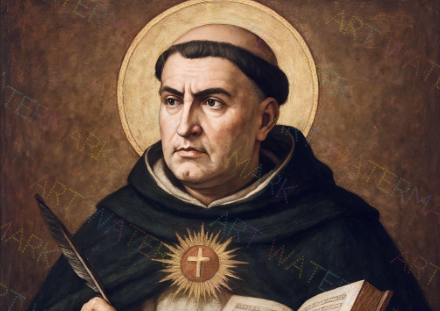
Thomas is usually portrayed in the black and white habit of the Dominican Order. His symbols include a book, a quill, a monstrance, a sunburst, and sometimes an ox. The sunburst represents his theological illumination, the book his scholarship, and the Eucharistic imagery his Eucharistic theology. The ox recalls the story of Albert the Great recognizing his extraordinary potential. His feast is celebrated on 28 January.
Music and Worship
His Eucharistic hymns are among the most beloved works of Catholic devotional literature. Pange Lingua has been used in Eucharistic worship for centuries, and its final verses are commonly sung as Tantum Ergo. These hymns show how closely theology and worship were joined in his life. His theological understanding became prayer, his intellectual work became poetry, and his philosophy became worship. It is one of the most beautiful aspects of his legacy.
Modern Relevance and Lessons for Today
Faith and Reason in an Age of Information
Modern society provides enormous amounts of information, and people meet competing claims about religion, science, politics, morality, and identity every day. Thomas’s method encourages careful reasoning. Instead of immediately accepting or rejecting an idea, ask: What exactly is being claimed? What evidence supports it? What assumptions does it depend on? Are there alternative interpretations? What follows logically from the argument? This discipline remains valuable.
Critical Thinking Without Fear
Thomas’s habit of stating objections before answering them is a powerful model. He did not pretend that difficult arguments did not exist. He brought them into the discussion. That is especially useful for Christians, because faith should not be afraid of questions. A believer can ask hard questions while remaining committed to seeking truth, and disagreement can be approached through disciplined reasoning instead of hostility.
Leadership
Thomas shows that authority should be connected to knowledge and responsibility. He did not pursue intellectual fame for its own sake, and his scholarship was directed toward teaching the Church. Leaders today can learn from that. Leadership should seek truth, serve people, cultivate humility, and recognize the limits of human knowledge.
Humility
Perhaps the greatest lesson is humility. Imagine producing thousands of pages of theology, becoming one of the great intellectuals in Christian history, and then saying at the end of your life that it all seems like straw compared with the reality of God. That is not intellectual contempt. It is intellectual humility. Thomas recognized that human language can say something true about God without comprehending God completely. Knowledge is valuable, but it should produce humility.
The Limits of Knowledge
The modern world often assumes that enough information can solve everything. But information is not wisdom. Knowledge can tell us how something works, and wisdom asks how it should be used. Technology can tell us what is possible, and wisdom asks what is good. Science describes processes, philosophy asks about meaning, and theology asks what those realities ultimately reveal about God. Thomas believed all truth ultimately belongs to God, so Christians need not fear genuine truth wherever it is found. Truth is not divided against itself.
Reflection and Practical Application
1. Let faith and reason work together. You do not have to choose between thoughtful inquiry and belief. Investigation can deepen understanding.
2. Take difficult questions seriously. Do not avoid them because they are uncomfortable. Study them, pray about them, and seek wisdom.
3. Read before reacting. When you meet an argument you dislike, read it carefully first and make sure you understand what the person actually said. Avoid caricaturing those who disagree.
4. Ask better questions. Instead of asking only “Do I agree?”, ask “What exactly is this person claiming?” and then “Why do they believe it?”
5. Study your faith. Set aside time each week to read Scripture, reliable Christian books, and Church history, and to explore hard questions.
6. Combine study with prayer. Begin by asking God for wisdom, and end by reflecting on how what you learned should affect your life.
7. Practice the virtues. Choose one virtue each month, such as patience, courage, generosity, honesty, humility, self-control, or compassion, and deliberately practice it. Virtue grows through repeated action.
8. Use your knowledge to serve. Education should not become a tool for arrogance. If you are trained in a field, teach, mentor, encourage, or volunteer. Knowledge becomes meaningful when it contributes to human flourishing.
9. Protect time for prayer. Thomas was one of history’s great intellectuals, yet he was deeply committed to prayer. Intellectual achievement cannot replace spiritual life.
When Knowledge Becomes Worship
One of the most powerful lessons of Thomas’s life is that Christianity does not separate the mind from the heart. We think, reason, pray, love, act, and worship, and Thomas brought these together. He could spend hours on a difficult theological question and then write a Eucharistic hymn full of devotion. He could build sophisticated arguments and still kneel in prayer. He could debate scholars and recognize that God’s reality exceeded his categories. Faith does not require intellectual laziness, and intellectual achievement does not require spiritual pride. The mind can become a pathway toward worship.
Frequently Asked Questions About Saint Thomas Aquinas
Who was Saint Thomas Aquinas?
A thirteenth-century Dominican friar, priest, theologian, and philosopher who became one of the most influential thinkers in Catholic Christianity.
When was he born?
Around 1225, in Roccasecca in the Kingdom of Sicily.
When did he die?
On 7 March 1274, at the Cistercian abbey of Fossanova.
Why is he famous?
For his contributions to Catholic theology and philosophy, especially on faith and reason, natural law, virtue, the sacraments, metaphysics, and the existence of God.
What is the Summa Theologiae?
His enormous systematic treatment of Christian theology, covering God, creation, humanity, morality, Christ, grace, the sacraments, and eternal life.
What are the Five Ways?
Five philosophical arguments concerning God’s existence, beginning from observations about change, causation, contingency, degrees of perfection, and order in nature.
Did he teach that faith and reason work together?
Yes. He taught that they have different but complementary roles. Reason can discover certain truths about reality and God, while revelation gives access to truths beyond natural human reason.
What did he teach about natural law?
That human beings can participate, through reason, in an objective moral order established by God. This became the foundation of the Catholic natural-law tradition.
What miracles are associated with him?
Traditional accounts associate him with healings and mystical experiences, particularly in prayer and before the Eucharist, as well as extraordinary events surrounding his relics.
What happened when he stopped writing?
Near the end of his life he reportedly had a profound spiritual experience, after which he stopped writing. Tradition says he told his secretary that, compared with what he had experienced, his writings seemed like “straw.”
When is his feast day?
28 January.
Why is he called the Angelic Doctor?
Because of the reputation his theology gained for clarity, depth, and intellectual precision.
Is he a Doctor of the Church?
Yes. Pope Pius V declared him one in 1567.
What religious order did he belong to?
The Dominican Order, officially the Order of Preachers.
Who taught him?
One of his most important teachers was Saint Albert the Great, a Dominican scholar who recognized his extraordinary abilities.
Closing Summary: The Scholar Who Learned to Worship
Saint Thomas Aquinas lived more than seven centuries ago. He lived in castles and monasteries, studied in medieval universities, debated philosophers and theologians, and wrote thousands of pages on God, humanity, morality, law, nature, and salvation. Yet his life was ultimately about something simpler: knowing God.
His greatness was not only an extraordinary intellect but the way he placed it in the service of truth. He refused to believe that faith required Christians to stop thinking, and he refused to believe reason could explain everything. He held the two together. Reason could search, philosophy could investigate, science could observe, theology could interpret revelation, prayer could transform the heart, and worship could carry the human person beyond intellectual knowledge into communion with God.
His story also shows that holiness takes different forms. Some saints are remembered for martyrdom, others for missionary work, charity, or mystical visions. Thomas is remembered partly for his mind. His books became part of his spiritual legacy, his arguments became instruments of Christian teaching, his hymns became prayers, and his humility gave his scholarship its deepest meaning.
Near the end of his life, after producing some of the most influential theological writing in Christian history, he looked at his work and regarded it as straw compared with what he had encountered in God. Whether or not every detail can be established historically, the spiritual message is powerful. Study matters, reason matters, education matters, but none of these is God. A book, an argument, a scientific discovery, or a beautiful hymn can point toward God, and God remains greater than every human explanation. That is the paradox at the heart of his legacy: the man who spent his life explaining God became convinced that God was beyond explanation. The scholar became a worshipper, the philosopher a servant, the teacher a pilgrim, and the great theologian learned that the final destination of knowledge is not pride but wonder.
For Christians today, that lesson is urgent. We can access more knowledge in seconds than a medieval scholar could meet in a lifetime, but information does not automatically produce wisdom. We need discernment, humility, moral courage, compassion, and truth, and, according to Thomas, we ultimately need God. His life invites us to ask better questions, study more deeply, live more virtuously, and pray more sincerely. It reminds students that education can be a calling, teachers that knowledge can be an act of service, leaders that wisdom requires humility, and believers that faith need not fear honest questions.
His legacy is less a particular argument than a way of living: seek truth, love wisdom, practice virtue, serve others, remain humble, and let every genuine discovery lead you closer to the God who is its source. We are called not merely to believe but to seek, not merely to seek but to understand, not merely to understand but to live, and not merely to live but to worship. For Thomas Aquinas, that was where every argument, every book, every prayer, and every question was finally pointing: toward God.