
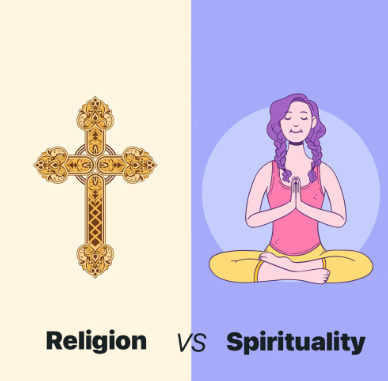
In an era of declining church attendance and rising personal faith, the tension between organized religion and individual spirituality has never felt more urgent. But is the distinction as clean as we like to think?
The Vocabulary We Live By
Walk into any bookshop today and you will find the evidence in the shelving itself. The category once labeled ‘Religion’ has been quietly expanded — or in some stores quietly replaced — by something broader: ‘Mind, Body, Spirit.’ The shift is not merely commercial. It reflects a genuine transformation in how millions of people in the Western world relate to questions of meaning, transcendence, and the sacred. Something that used to be housed almost entirely within the institutions of organized religion has escaped those walls and dispersed into yoga studios, meditation apps, ayahuasca retreats, Sunday morning hikes, and solo journals filled with gratitude lists.
The statistics are striking. Surveys across Europe, North America, and Australia consistently show declining affiliation with organized religion, especially among younger generations. Yet the same surveys often find that the majority of those who have left institutional faith still describe themselves as ‘spiritual.’ In the United States, the Pew Research Center has repeatedly found that a substantial and growing segment of the population identifies as ‘spiritual but not religious’ — a category that barely existed as a recognized self-description fifty years ago.
So what does ‘spiritual but not religious’ actually mean? And does the distinction between religion and spirituality represent a genuine philosophical divide, a sociological shift, a marketing phenomenon — or some combination of all three? These are not idle questions. How we answer them has real consequences for communities, for mental and physical health, for moral formation, and for the kinds of lives we build together.
Defining the Terms — and Why It Is Harder Than It Looks
At first glance, the distinction seems obvious. Religion, in the popular imagination, means institution: churches, mosques, synagogues, temples; creeds, dogmas, rituals; hierarchies of clergy, texts declared sacred, rules about how to live. Spirituality, by contrast, feels interior and unencumbered: a personal sense of connection to something larger than oneself, cultivated on one’s own terms, free from the coercive demands of orthodoxy or the embarrassments of institutional scandal.
But push on these definitions and they begin to blur. Most of the practices that people today describe as ‘spiritual’ — meditation, contemplative prayer, fasting, retreat, the use of sacred texts — were developed within religious traditions. The mindfulness movement that has colonized corporate wellness programs is a largely secularized version of Buddhist practice. The concept of the ‘soul,’ which is central to much spiritual language, is a product of specific philosophical and theological traditions — Greek, Jewish, Christian, Islamic — not a self-evident universal given.
Conversely, the great religious traditions have always contained within them a powerful current of inwardness, personal transformation, and direct encounter with the divine that resists reduction to mere institutional compliance. Christian mysticism, Sufi Islam, Jewish Kabbalah, Hindu Advaita Vedanta, Zen Buddhism — all of these represent strands within organized religion that sound, in their emphasis on direct experience over doctrine, remarkably like what people today mean by ‘spirituality.’ St. John of the Cross and Meister Eckhart would not have recognized a sharp distinction between their religious vocation and their inner spiritual life.
The mystics of every tradition have always known that the map is not the territory — that religion, at its best, is a finger pointing at the moon, not the moon itself.
The sociologist Robert Bellah, writing in the 1980s, coined the term ‘Sheilaism’ to describe a form of privatized faith — named after an interviewee named Sheila Larson who said she had her own ‘little voice’ guiding her, which she called ‘Sheilaism.’ Bellah was not sympathetic; he saw this as the logical endpoint of American individualism applied to religion, the reduction of faith to personal preference. But his critique, fair or not, captures something real about the spiritual marketplace of the present day.
What Religion Offers That Spirituality Often Cannot
There is a tendency in contemporary spiritual discourse to treat religion as spirituality with the good parts stripped out and replaced with guilt, hierarchy, and scandal. This is understandable but unfair. Organized religion, whatever its failures, has historically offered things that purely individual spirituality struggles to provide.
The first is community. Religion, at its best, creates thick human bonds that extend across differences of temperament, class, and background. You do not choose your congregation the way you choose your yoga class. You sit next to the difficult person, the person whose politics you despise, the person who smells odd, the person going through a crisis you cannot imagine. This involuntary quality — what sociologists call ‘bridging social capital’ — is precisely what makes religious community so different from the affinity groups that personal spirituality tends to produce. A spirituality of one is a spirituality that will never be challenged by a neighbor.
The second is continuity. Religious traditions carry within them centuries or millennia of accumulated wisdom about how to live — how to face death, how to grieve, how to raise children, how to mark the transitions of life, how to recover from failure. This wisdom is imperfect and often flawed, but it is real. It has been tested by generations of human beings in extreme circumstances. The spiritual seeker who constructs a personal practice from scratch, drawing eclectically on whatever resonates, may be deeply sincere, but they lack this depth of tested tradition. As the philosopher Alasdair MacIntyre argued, we can only really reason about ethics from within a tradition; the idea that we can step outside all traditions to find some neutral vantage point is an Enlightenment illusion.
The third is accountability. Religious traditions, even flawed ones, typically include structures of moral accountability — community standards, confession or its equivalent, the weight of shared expectations. Personal spirituality, by contrast, can easily become what the theologian Paul Tillich called ‘cheap grace’: the sense of inner peace and connection without the difficult work of moral change. It is telling that many people who describe their spiritual practice mention what it does for them — peace, clarity, gratitude, resilience — rather than what it demands of them.
The fourth is meaning-making in extremis. When confronted with the death of a child, a diagnosis of terminal illness, or the collapse of everything one has built, the resources of a rich religious tradition are of a different order from those of a personal wellness practice. The Book of Job, the Psalms of lament, the Sufi poetry of grief and longing, the Buddhist teachings on impermanence and suffering — these are not comfort but confrontation. They do not make death easier; they insist that the question of death be faced honestly, within a community that has faced it before.
What Spirituality Sees That Religion Sometimes Misses
And yet the critique of institutional religion is not without substance. The horrors visited on individuals and communities by religious institutions — the sexual abuse scandals that have devastated the Catholic Church, the use of religion to sanctify slavery and colonialism, the violence done in God’s name across centuries and continents — these are not aberrations to be explained away. They are features, at least in part, of what happens when access to the sacred becomes the monopoly of a human institution with interests to protect.
The spiritual seeker’s instinct that the inner life cannot be fully mediated by an institution is not merely self-serving. It reflects a genuine theological insight: that no human organization can fully contain or control the sacred. The Hebrew prophets spent centuries saying exactly this to the Israelite religious establishment. Jesus of Nazareth said it to the Temple authorities. The Sufi poets said it to the Islamic legalists. The Protestant Reformers said it — with mixed results — to Rome. The critique of institutional religion from within spiritual experience is as old as religion itself.
Moreover, the spiritual emphasis on direct experience as a valid source of knowledge about ultimate reality is philosophically serious. The mystics of multiple traditions have argued, with striking convergence, that the most important things about human existence cannot be reached through doctrinal assent or ritual compliance alone — they must be encountered. William James, in his landmark 1902 work The Varieties of Religious Experience, argued that religious experience in its most direct and personal form is the root from which all religious institutions and doctrines ultimately spring. On this reading, spirituality is not a dilution of religion; it is religion’s living source.
Perhaps the real question is not religion versus spirituality, but whether our practices — whatever we call them — are actually transforming us, making us more capable of love, more honest about our failures, more present to the suffering of others.
There is also something to be said for the spiritual emphasis on universality. The world’s religious traditions have too often functioned as boundary markers — defining who is in and who is out, who is saved and who is damned, who belongs and who must be excluded. The spiritual sensibility that recognizes something sacred in all human beings, regardless of their tradition or lack of one, and that finds resonances across the barriers of doctrine, is not necessarily shallower than orthodox exclusivism. It may be responding to something real about the nature of ultimate reality that the traditions, in their more parochial moments, obscure.
The Neuroscience and Psychology of the Question
Beyond the theological and sociological arguments, there is a growing body of empirical research on the effects of religious and spiritual practice on human wellbeing — and the findings complicate easy narratives on both sides.
Studies consistently find that religious affiliation and regular attendance are associated with better physical health outcomes, greater longevity, lower rates of depression and anxiety, stronger social support networks, and higher levels of reported life satisfaction. The Harvard epidemiologist Tyler VanderWeele has produced some of the most careful research in this area, and his conclusions are striking: regular religious service attendance is associated with significantly lower mortality rates, less depression, greater social integration, and more civic engagement.
But here the distinction between religion and spirituality begins to matter empirically as well. Research by Crystal Park and others suggests that it is not doctrinal belief per se that drives these outcomes, but the meaning-making frameworks and community ties that religion provides — both of which can, in principle, be found outside institutional religion. Studies on meditation and mindfulness practice, drawn primarily from Buddhist and contemplative traditions but now practiced largely outside religious contexts, show robust benefits for mental health, immune function, and emotional regulation.
The picture that emerges is nuanced. The community, ritual, and continuity that organized religion typically provides seem to have real, measurable effects on human flourishing. But these effects are not the exclusive property of institutional religion — they are the effects of the underlying practices and relationships, whatever container holds them.
Is ‘Spiritual But Not Religious’ a Stable Identity?
One of the most interesting questions about the contemporary spiritual landscape is whether ‘spiritual but not religious’ is a stable long-term identity or a transitional one. There are reasons to doubt its stability.
Personal spirituality, by definition, lacks the communal reinforcement and institutional memory that help traditions survive across generations. Studies suggest that parents who raise their children in a tradition of personal spirituality rather than religious community are far less likely to pass on any form of faith — even personal spirituality itself — to their children. The transmission problem is real: spirituality without community is difficult to hand on.
There is also the question of what happens to personal spirituality under pressure. The practices that sustain a sense of inner peace and meaning in good times — meditation, journaling, time in nature — may prove insufficient when confronting genuine catastrophe. The therapist and author Irvin Yalom has written movingly about the moments when his patients, facing death, find that their constructed personal beliefs simply do not hold. It is at such moments that the weight and depth of a living tradition — with its accumulated wisdom, its communal support, its unflinching honesty about suffering — proves its worth.
At the same time, institutional religion that does not feed the inner life will also fail to hold people. The emptiest religion — all structure and no substance, all doctrine and no encounter — is also unstable in the long run. The great religious traditions have known this. They have always contained, alongside their institutional structures, currents of mysticism, contemplation, and direct experience that keep the inner fire burning.
Does the Distinction Matter?
We return, finally, to the question posed in our title. Does the difference between religion and spirituality actually matter?
It matters sociologically. The decline of institutional religious affiliation is reshaping communities, families, and the social fabric in ways we are only beginning to understand. The institutions that organized religion built — hospitals, schools, food banks, orphanages, addiction recovery programs, networks of mutual care — do not maintain themselves. The social capital that religious community generates does not simply transfer to individualized spiritual practice.
It matters philosophically. The question of whether we can access truth about ultimate reality through personal experience alone, or whether we need the checks and challenges of a tradition, community, and inherited wisdom, is not trivial. Both extremes — the institution that demands blind obedience, and the individual who trusts nothing but their own inner voice — have well-documented failure modes.
It matters pastorally. People facing suffering, death, moral failure, and the need for genuine transformation need more than a wellness practice. They need a tradition deep enough to hold them — and ideally, a community willing to go into the darkness with them.
And yet, in another sense, the distinction matters less than we often assume. The difference between a deeply committed religious practitioner who has genuinely encountered the sacred and is being genuinely transformed by that encounter, and a deeply committed spiritual practitioner who is doing the same — that difference may be largely one of vocabulary and institutional home. Both are engaged in the most important human project: the attempt to live, honestly and fully, in the face of our mortality, our fallibility, and the mystery of existence.
The real division is not between religion and spirituality. It is between depth and shallowness; between practices that genuinely transform and those that merely comfort; between a faith that makes demands and a faith that only offers benefits. These distinctions cut across the religion-spirituality divide. There is deep religion and shallow religion; deep spirituality and shallow spirituality. The challenge — for the churchgoer and the meditator alike — is the same: to go deeper than the form, to let the practice reach the places that actually need changing.
The deepest spiritual traditions of the world agree on this much: the sacred is not a feeling to be cultivated but a reality to be encountered — and that encounter will cost you something.
Perhaps the most honest answer to the question ‘Does the distinction matter?’ is: it matters enough to think carefully about, but not so much that we should let it prevent us from recognizing genuine wisdom and genuine transformation wherever we encounter them. The person who sits in a pew every Sunday and the person who meditates alone at dawn are, at their best, engaged in the same ancient and irreplaceable human project. They would do well to speak to each other.
This article is intended as an open reflection for readers of all faiths and none. The questions it raises have no simple answers — only better and worse ways of sitting with them.