
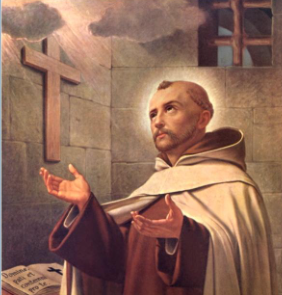
Saint John of the Cross is one of the most profound spiritual writers in Christian history. A Spanish Carmelite friar, priest, poet, reformer, mystic, and Doctor of the Church, he devoted his life to explaining the mysterious journey of the soul toward God.
Born in 1542 in Fontiveros, near Ávila in Old Castile, John lived in a turbulent age. The Protestant Reformation had fractured Western Christianity, Catholic reform was reshaping religious life, and Spain was becoming one of Europe’s most powerful political and cultural forces. Within the Church there were vigorous debates about discipline, spiritual renewal, education, clerical reform, and the right expression of devotion.
Into this world came a man who would become famous for writing about something many people find hard to understand: spiritual darkness. John wrote about times when believers pray but do not feel God’s presence, when familiar comforts disappear, and when a person who sincerely desires God seems to meet silence instead of reassurance. His concept of the “dark night of the soul” has since passed into everyday language far beyond Catholic spirituality.
Yet in John’s original thought, the dark night was not simply depression, sadness, or a difficult season. It referred to a profound process of purification in which God gradually frees the soul from unhealthy attachments and prepares it for deeper union with him.
His life gave credibility to his teaching. He knew childhood poverty, loss, demanding religious discipline, opposition, imprisonment, physical suffering, loneliness, and misunderstanding. He was imprisoned by members of his own religious order during the Carmelite conflicts of the sixteenth century, and in confinement he composed poetry that became some of the most celebrated religious literature in Spanish. His partnership with Saint Teresa of Ávila was equally important: together they became central figures in reforming the Carmelite tradition.
His story is not merely the biography of a mystic. It is a story of perseverance, reform, suffering, creativity, prayer, and radical love for God.
Historical Background and Early Life
Birth and Family
John was born in 1542 in Fontiveros, a small village near Ávila, and baptized Juan de Yepes y Álvarez. His parents were Gonzalo de Yepes and Catalina Álvarez. The family knew real poverty. Gonzalo came from a family of higher standing but was rejected by his relatives after marrying Catalina, a woman of humbler background who worked in the textile trade. He died while John was still very young, leaving Catalina to raise her children in difficult circumstances.
This early poverty matters for his later spirituality. John did not develop his understanding of Christian detachment in comfort. He knew what it meant to live without security.
After his father’s death, John moved with his mother and brother Francisco to Medina del Campo when he was about nine. Medina was a significant commercial and cultural center, and there he encountered education, religious institutions, charitable work, and the intellectual environment that would shape his future.
Education and Early Work
His early life combined study with humble labor. He attended the Colegio de los Doctrinos, performing small tasks for the institution, and later worked as a nurse at the Hospital of the Conception. This exposed him to suffering and human vulnerability. Before he was a theologian or mystic, he had met ordinary people facing illness, poverty, and dependence.
He then studied at the Jesuit college in Medina del Campo, receiving training in the humanities, rhetoric, and classical languages. These gave him intellectual tools that show in his writing. John was not only a man of mystical experiences but a disciplined thinker who carefully explained his understanding of spiritual growth.
Spain in the Sixteenth Century
John lived during the Spanish Golden Age, a period of enormous cultural and religious activity. Spain was a major imperial power, and the Church was undergoing reform after the Protestant Reformation. The Council of Trent, meeting from 1545 to 1563, addressed major doctrinal and disciplinary questions.
Religious life itself was under examination. Some communities had come to worry about declining discipline or departure from earlier ideals, and reformers wanted to recover simplicity, prayer, poverty, contemplation, and stricter observance. John would become one of the central figures of this movement within the Carmelite Order. His spiritual journey cannot be separated from the wider Catholic reform of his age.
Spiritual Awakening and Path to Sainthood
Entering the Carmelites
At about eighteen, John entered the Carmelite Order in Medina del Campo and took the religious name Juan de Santo Matía. He later studied humanities and philosophy at the University of Salamanca, one of Europe’s leading centers of learning, and was ordained a priest in 1567. He was already serious about religious life, but his vocation was about to take a decisive turn.
Meeting Teresa of Ávila
In 1567 John met Teresa of Jesus, better known as Saint Teresa of Ávila, in a meeting that became one of the defining moments of his life. Teresa was already reforming the Carmelite women’s communities, seeking a stricter form of life centered on prayer, poverty, community, and contemplation, and she hoped to establish a reformed branch for men as well. John was drawn to the project, and the two became close spiritual collaborators. It is one of the remarkable partnerships in Christian history: Teresa, the experienced mystic and reformer, and John, the younger priest with intellectual gifts and a deep longing for contemplative life.
The Foundation at Duruelo
In 1568 John joined the first community of reformed Carmelite men at Duruelo. This small beginning grew into the Discalced Carmelite reform. When the friars renewed their profession according to the primitive Carmelite rule, John took the name history would remember him by: John of the Cross.
The name became deeply symbolic. For John the cross was not only an object of devotion but a spiritual path. Following Christ meant allowing God to transform the deepest desires of the human person.
The Journey Toward God
John believed that human beings can become attached to many things. Some attachments are plainly sinful. Others look good but can still become obstacles when they take the place that belongs to God. Spiritual maturity therefore requires purification. This does not mean hating creation or rejecting legitimate human affection. It means placing everything in right relationship to God. The goal is not emptiness for its own sake. The goal is love.
Major Works, Teachings, and Contributions
John is especially famous for four major works: The Ascent of Mount Carmel, The Dark Night, The Spiritual Canticle, and The Living Flame of Love. The Vatican identifies these as his principal works and stresses their importance for Christian mystical theology.
The Ascent of Mount Carmel
The Ascent describes the soul’s journey toward union with God, using Mount Carmel as an image of spiritual perfection. The ascent demands purification, and John challenges believers to examine their attachments, desires, fears, ambitions, and even their spiritual consolations. The crucial question is not “What do I want from God?” but “Do I want God himself?” That distinction is central to his spirituality.
The Dark Night
Perhaps his most famous work, the Dark Night describes a process through which God purifies the soul. There are periods when prayer feels dry and the emotional consolation that once made prayer easy is gone. John warns against assuming at once that God has abandoned the person. The loss of familiar consolation may be part of spiritual growth, as the soul learns to love God without relying entirely on feelings. The phrase is now used widely in popular culture, but John’s meaning is far deeper than a bad season.
The Spiritual Canticle
One of his most beautiful works, the Spiritual Canticle is written in poetic form, using the image of a bride searching for her beloved, with the Song of Songs in the background. John uses the language of romantic love to describe the soul’s longing for God. This does not reduce Christianity to emotion. It expresses a profound theological reality: the human soul is created for communion with God. The journey begins in longing, passes through purification, and reaches deeper union.
The Living Flame of Love
In this work John develops the theme of transformation, comparing the work of the Holy Spirit to fire. A piece of wood placed in a fire is gradually consumed by it and shares its heat and brightness. So the soul is transformed by divine love. The goal of Christian spirituality is not merely moral improvement but transformation through love.
John as Poet
John was also one of the great lyric poets of Spanish literature, studied by literary scholars as well as theologians. What is extraordinary is the union of beauty and theology. He expressed complex spiritual ideas through images of mountains, gardens, fire, night, love, light, wounds, searching, and union, making his work emotionally accessible while remaining intellectually profound.
Miracles, Signs, and Supernatural Accounts
John is associated with many stories of mystical experiences, visions, and miracles. It is important to distinguish established historical facts, traditional devotional accounts, and later reports of extraordinary phenomena. The Church’s formal procedures for causes of saints distinguish carefully between a person’s life, reputation for holiness, intercessory power, and alleged miracles, and modern investigations examine alleged miracles through a structured process.
Mystical Experiences
His writings show that he believed deeply in mystical union with God and describe divine love, spiritual illumination, and profound contemplation. Surprisingly, though, he often warned Christians not to become obsessed with visions or supernatural experiences. For John, extraordinary experiences were not the goal. God was the goal.
Discernment
John believed people could misread spiritual experiences. Someone might feel an emotional high in prayer and assume it marks spiritual maturity. John challenged that assumption. Real growth produces humility, love, patience, obedience, detachment, and charity. A person who claims extraordinary experiences but becomes proud has not understood the purpose of contemplation.
Devotional Tradition
Traditional accounts associated with John include healings, mystical experiences, and extraordinary events attributed to his intercession, and these contributed to his reputation for holiness. Responsible writing should not present every traditional story as historically proven. The main evidence for his importance lies not only in miracle traditions but in his life, writings, reform work, and the Church’s long reception of his teaching.
Trials, Persecutions, and Controversies
John’s life was not peaceful, and ironically one of his greatest sufferings came from conflict within the Carmelite Order itself.
Conflict Over Reform
The reform led by Teresa and John challenged established patterns in the Order. The reformers wanted stricter observance, and others opposed aspects of the movement. The dispute touched authority, governance, discipline, and the future direction of Carmelite life, and it became increasingly serious.
Imprisonment in Toledo
In 1577 John was seized and taken to Toledo, where he was imprisoned in a convent of the unreformed Carmelites. According to historical accounts, his imprisonment lasted more than nine months and involved severe physical and psychological hardship. He was kept in a small, poorly ventilated cell, poorly fed, and harshly treated. For a man who would become famous for writing about spiritual darkness, this was not theoretical. He experienced literal darkness.
Poetry from the Cell
His suffering became bound up with his poetry. During the imprisonment he composed verses, including material associated with the Spiritual Canticle. The image is striking: a man in a dark cell writing of the soul’s search for the Beloved. His circumstances could have destroyed him. Instead they became part of the setting in which some of his most beautiful spiritual poetry was born.
Escape
In August 1578 John escaped and found refuge with the Discalced Carmelite nuns. The ordeal left deep marks, but it did not end his commitment to reform, and he continued to serve the Carmelite movement.
Misreadings of His Spirituality
His writings have also drawn theological discussion. Some readers have taken the dark night as an instruction to reject ordinary human joy, which misrepresents him. John was not advocating emotional numbness. He described a process in which the soul becomes less dependent on created consolations and more oriented toward God. His language of detachment is demanding but fundamentally relational. The aim is not to become less able to love but to become capable of deeper love.
Death, Canonization, and Posthumous Influence
Final Years
After his imprisonment John continued his work in the Discalced reform. He held various leadership posts and spent considerable time in Andalusia, especially Granada, while continuing to develop his writings. Internal difficulties arose again, and in 1591 he was relieved of his responsibilities and was preparing for a possible assignment to Mexico. His health failed, and he fell seriously ill near Jaén. Accounts of his last days stress patience and spiritual serenity despite his suffering.
Death
John died in the night of 13 to 14 December 1591. According to the Vatican biography, he died as his fellow religious were reciting Matins, having reportedly said, “Today I am going to sing the Office in Heaven.” His death was remembered as the completion of a life centered on prayer.
Beatification and Canonization
Pope Clement X beatified John in 1675, and Pope Benedict XIII canonized him in 1726. In 1926 Pope Pius XI proclaimed him a Doctor of the Church. He is traditionally known as the Doctor Mysticus, the Mystical Doctor, a title recognizing the exceptional importance of his teaching on the Christian spiritual life.
His canonization did not merely celebrate an unusual mystic. It recognized a body of teaching that has guided believers for centuries, especially contemplatives, religious communities, spiritual directors, theologians, and Christians seeking deeper prayer.
Cultural, Artistic, and Global Impact
Literature
John is regarded as one of the most important lyric poets in Spanish literature, and his poems have been translated into many languages. Writers and scholars have studied his symbolism, metaphor, biblical imagery, and mystical language. His poetry shows how religious experience can become literary art without losing theological depth.
Christian Spirituality
His writings have influenced generations of spiritual authors. His teaching on detachment, contemplation, prayer, suffering, and divine union has been absorbed into Catholic spiritual direction and is read well beyond Carmelite circles.
John and Teresa
His name is inseparable from Teresa’s. Together they transformed the Carmelite tradition: Teresa brought extraordinary organizational and spiritual leadership, and John brought theological depth, spiritual direction, poetry, and reforming energy. Their partnership shows how renewal can come through collaboration.
Feast Day and Symbols
John is celebrated on 14 December, during Advent, the season of waiting, longing, and expectation. There is a beautiful connection: Advent asks Christians to wait for Christ, and John teaches the soul how to wait for God when his presence seems hidden. Artistic symbols associated with him include the cross, a book, a mountain, fire, Carmelite dress, and images of contemplative prayer. The cross is especially significant, reflecting both his religious name and his theology of self-giving love.
Modern Relevance and Lessons for Today
Spiritual Emptiness and Silence
Modern culture offers constant stimulation: notifications, entertainment, advertising, social media, information. Silence can feel uncomfortable. John offers another possibility: silence as a place of encounter. A person does not always need more stimulation. Sometimes the soul needs stillness.
When Prayer Feels Dry
Many Christians go through seasons when prayer is difficult, comfort is absent, and God seems distant. John offers reassurance. Dryness does not always mean faith has failed. Sometimes a person is being invited to move from dependence on feelings toward deeper trust. This should not be used to dismiss serious mental-health struggles. Spiritual dryness and clinical conditions are not automatically the same thing, and John’s teaching is about spiritual purification, not a substitute for professional care.
Detachment in a Consumer Culture
His message about attachment speaks to a consumer society. People can become attached to possessions, status, popularity, achievement, appearance, career, relationships, or recognition. His question remains powerful: can you possess something without letting it possess you? Christian detachment is not necessarily rejection. It is freedom.
Leadership Through Humility
John knew authority struggles. He was both a leader and a prisoner, and he learned that institutional conflict can arise even among sincere religious people. His example urges leaders toward humility and service rather than personal control.
Suffering and Resilience
His imprisonment is a powerful example of endurance. He does not romanticize suffering. He experienced real deprivation, yet he kept praying and creating. For Christians facing hardship, his life is a reminder that suffering need not have the last word.
The Interior Life
One of his greatest messages is the importance of interior transformation. People can change external circumstances without changing their hearts. Christian spirituality asks a deeper question: who are you becoming? John’s answer is that the soul must grow increasingly able to love God and neighbor.
Reflection and Practical Application
1. Create moments of silence. Set aside several minutes each day without phone, television, music, or unnecessary conversation. Sit quietly before God. You do not need elaborate words. Simply become attentive.
2. Examine your attachments. Ask what you are afraid to lose, whose approval you constantly need, what possession or achievement has become too important, and what would make you feel worthless if you lost it.
3. Learn to pray without depending on feelings. Some days prayer feels powerful and some days ordinary. Do not measure its value by emotion. Faith involves trust.
4. Choose love over spiritual pride. Ask whether you are becoming more patient, forgiving, compassionate, and humble. If spiritual practice produces arrogance, something has gone wrong.
5. Accept slow growth. A soul is not transformed overnight. Christian maturity develops gradually.
6. Read Scripture slowly. Choose a short passage and ask what it reveals about God, what it reveals about you, and what response God is inviting.
7. Turn suffering into prayer. Bring pain honestly before God. This does not mean pretending suffering is good. It means refusing to let it become meaningless.
8. Seek wise spiritual guidance. A trustworthy priest, pastor, spiritual director, or mature mentor can help distinguish real spiritual growth from confusion or unhealthy religious pressure.
9. Remember that the goal is love. Beneath the language of purification is a message about love. God is not stripping the soul of good things simply to leave it empty. The purpose is deeper communion with him.
Closing Summary: The Saint Who Taught the World to Walk Through the Darkness
Saint John of the Cross remains one of Christianity’s most profound teachers because he refused to reduce faith to comfort. He understood that the journey toward God holds joy and sorrow, clarity and uncertainty, consolation and silence. He knew suffering, poverty, rejection, imprisonment, and loneliness. He also knew beauty, friendship, prayer, and poetry. Above all he believed the deepest purpose of the Christian life is union with God through love.
His teaching on the dark night is therefore not ultimately a message of despair but of hope. The night is not the end. The mountain has a summit. The fire does not destroy the soul but transforms it. The search for the Beloved does not end in emptiness but moves toward communion.
His life also reminds us that holiness does not always look spectacular. Sometimes it looks like staying faithful when no one understands, praying when prayer is dry, forgiving those who have wounded us, surrendering an attachment that has quietly become more important than God, or choosing love when pride would be easier. John was formed not by comfort alone but by surrender. Christian transformation is not about becoming impressive. It is about becoming free enough to love.
Centuries after his death, his words still speak to people searching for God in a noisy, distracted world. He invites us to slow down, grow quiet, examine the heart, release unhealthy attachments, trust God through uncertainty, and persevere through suffering. Even when the soul walks through darkness, God may still be leading it toward light.
His timeless invitation is this: do not be afraid of the journey, do not mistake silence for abandonment, do not confuse comfort with holiness, and do not let suffering persuade you that God has disappeared. Keep walking, keep praying, keep loving, and keep moving toward the One John spent his life seeking. For the Christian, the deepest destination is not spiritual success. It is God himself.