
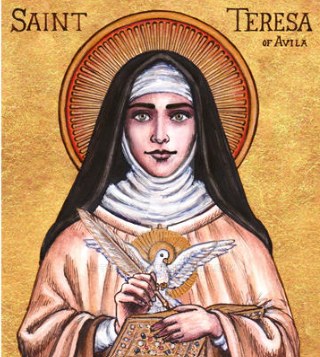
Few figures in Christian history combine mysticism, courage, intellectual depth, humor, leadership, and practical wisdom as vividly as Saint Teresa of Ávila. She lived in sixteenth-century Spain, one of the most turbulent periods in European and Catholic history, and she lived as a woman in an age when female education, theological scholarship, institutional leadership, and public influence were severely restricted. Yet Teresa became a reformer, writer, spiritual teacher, religious founder, mystic, and administrator, and one of the most important voices in Christian spirituality.
Her life was not a story of uninterrupted holiness. She struggled with illness and long periods of spiritual dryness. People questioned her mystical experiences, and religious authorities viewed her with suspicion. She dealt with financial problems, difficult personalities, political complications, and the practical challenges of establishing new religious communities. Through all of it she developed a spirituality centered on friendship with God. Her most famous description of prayer is that it is “an intimate sharing between friends.” Prayer, for Teresa, was not merely reciting words. It was relationship, conversation, and presence, the work of learning to remain with Christ.
Her books, especially The Life of Teresa of Jesus, The Way of Perfection, and The Interior Castle, have shaped Christian approaches to contemplative prayer for centuries. She was canonized in 1622 and declared a Doctor of the Church in 1970, one of the first women to receive that title. Her legacy remains strikingly contemporary. In an age of anxiety, distraction, exhaustion, and constant communication, her invitation is simple but demanding: go inward, become attentive, learn to pray, seek God honestly, and let that relationship transform the way you live.
Historical Background and Early Life
Born in Sixteenth-Century Spain
Teresa Sánchez de Cepeda y Ahumada was born on 28 March 1515 in Ávila, a fortified city in the Kingdom of Castile. Spain was emerging as one of Europe’s most powerful states. The reigns of Ferdinand and Isabella had transformed the Spanish kingdoms, the reconquest of Granada in 1492 had brought enormous political and religious change, and the Spanish monarchy and empire were expanding.
At the same time, European Christianity was being shaken by the Protestant Reformation. Martin Luther’s challenge began in 1517, just two years after Teresa’s birth. By the time she reached adulthood, questions of religious authority, doctrine, Scripture, clerical discipline, and Christian identity were being fiercely debated across the continent. The Catholic Church would answer at the Council of Trent, which met intermittently between 1545 and 1563. Teresa’s life therefore unfolded in an era of intense religious tension and reform, and it shaped both her opportunities and the suspicions she faced.
Family and Cultural Environment
Teresa came from a prosperous family of both Christian and converso ancestry. Her father, Alonso Sánchez de Cepeda, was a respected and relatively wealthy man. Her mother, Beatriz de Ahumada, was deeply religious and encouraged reading in the household. Teresa was one of several children.
Her childhood was shaped by books and religious imagination. She later recalled reading stories of saints and martyrs, and they affected her profoundly. According to her autobiography, she and her brother Rodrigo were once so fascinated by martyrdom that they set off toward lands held by Muslims, hoping to die for Christ. Their family discovered the plan and brought them home. The story is often told with humor, but it reveals something real about the young Teresa. She was fascinated by eternity, by God, and by heroic holiness, and she was already thinking about what it would mean to give her whole life to Christ.
Books, Emotion, and Imagination
Teresa’s spiritual formation was not purely intellectual. Alongside her reading she developed a warm, emotional relationship with Christ. That combination of imagination, reading, prayer, devotion, and desire for heroic holiness would remain characteristic of her spirituality for the rest of her life.
Losing Her Mother
Teresa suffered a major loss when her mother died while Teresa was still a girl. She later described turning to the Virgin Mary and asking Mary to be her mother, a moment that began a lifelong devotion. The grief also deepened her awareness of human fragility. Life could change suddenly, people could disappear, and earthly security was uncertain. Gradually these experiences became part of a larger lesson: God must become the deepest source of stability in a person’s life.
Adolescence and Divided Desires
Teresa’s teenage years were not simple. She was deeply religious, yet she also enjoyed social life and was drawn to worldly pleasures and friendships. One of the most remarkable features of her autobiography is her candour about this. She did not present herself as someone who had always lived at an extraordinary spiritual level. She wrote openly about vanity, relationships, distractions, and divided desires. That honesty makes her unusually relatable. She knew what it meant to want God while also wanting other things, and that tension became central to her spiritual understanding.
Spiritual Awakening and Path to Sainthood
Entering the Carmelites
In 1535 Teresa entered the Carmelite convent of the Incarnation in Ávila. The decision pained her father, who was reluctant to let her go, and Teresa herself later described how hard it was to leave her family. Yet she believed religious life was the path God was calling her to.
Her early years in the convent were complicated. She suffered periods of serious illness and intense physical pain. Her health was fragile for much of her life, and at one point her condition was so grave that she was believed to be near death, with paralysis and other severe difficulties. She recovered, but she was never entirely free of health problems.
This suffering shaped her spirituality. She learned that growth in the spiritual life does not always come through dramatic experiences. Sometimes holiness grows through endurance, through patience, through accepting weakness, and through continuing to pray when prayer is difficult.
Years of Struggle in Prayer
For many years Teresa found it hard to keep a consistent, deep life of prayer. She later admitted this plainly. Yet she increasingly recognized that prayer was essential. A decisive influence was spiritual reading and meditation on Christ, and she became focused on the humanity of Jesus: his life, suffering, death, resurrection, and presence. For Teresa, prayer was not an escape from reality but a way of becoming deeply aware of Christ within reality.
A Turning Point
Teresa experienced several profound turning points. One of the most important involved an image of the suffering Christ. She described being deeply moved by it and realizing how inadequately she had responded to God’s love. From then on she pursued prayer with new seriousness.
She gradually experienced forms of contemplative prayer that she described in extraordinary language. Her mystical experiences included visions, interior locutions, ecstasies, spiritual consolations, an intense awareness of God’s presence, and experiences of deep union with God. These experiences would eventually attract both admiration and suspicion.
Major Works, Teachings, and Contributions
Prayer as Friendship
Teresa’s understanding of prayer is one of the main reasons she remains influential. She believed prayer meant moving gradually deeper into relationship with God, and she described it as an interior journey. The soul, in her image, is a garden, and God is the one who gives it life. Prayer is the work of cultivating the garden, and she described different ways of “watering” it that correspond to different forms of prayer. Sometimes the person must work hard. Sometimes grace seems to flow easily. Sometimes prayer becomes almost entirely receptive. What matters is perseverance.
Her description of prayer as “an intimate sharing between friends” changed how many ordinary Christians could understand contemplation. Prayer was not reserved for scholars, priests, or mystics. Any Christian could sit quietly before God, speak honestly, listen, reflect, love, and remain present. That is why her spirituality remains so accessible.
The Interior Castle
Written in 1577, The Interior Castle is among Teresa’s greatest works. It describes the soul as a castle containing many rooms, or “mansions,” and the spiritual life as a journey deeper into that castle. The outer rooms represent the early stages of prayer. As the soul moves inward, prayer deepens, until Teresa describes profound union with God.
The imagery turns abstract theology into something visual. Imagine standing outside a magnificent castle, then entering. There are rooms, corridors, and chambers. Some are bright and some dark, some are full of distractions, and others are filled with peace. The journey toward God is an interior pilgrimage.
Its theological significance is considerable. Teresa emphasizes that God is not merely an external idea but can be encountered in the deepest dimensions of the human person. This does not mean God is simply identical with the self. Her mystical theology stresses God’s presence and transforming grace, and the Christian journey as a movement toward deeper communion. Crucially, she does not measure spiritual maturity by extraordinary experiences. The evidence of genuine growth is transformed character. True prayer should eventually produce love.
The Way of Perfection
Teresa wrote The Way of Perfection as guidance for her Carmelite sisters. It covers prayer, community life, humility, obedience, detachment, charity, and spiritual discipline, and it gives special attention to the Our Father, teaching readers how to pray it with greater depth. Teresa keeps connecting contemplation with love. Prayer cannot become an excuse for selfishness, and if prayer does not make a person more loving, something has gone wrong.
The Life of Teresa of Jesus
Her autobiography is one of the most important in Christian mystical literature. She writes about her childhood, vocation, illnesses, prayer, struggles, mystical experiences, conversion, reform work, and understanding of grace. It is both theological and deeply personal. Her style is conversational, and she can be humorous, direct, emotional, and self-critical, often sounding like someone sitting across the table explaining what happened. This accessibility has contributed greatly to her enduring popularity.
Humility Without Pretending
Humility was central to Teresa’s spirituality, but it did not mean pretending to have no abilities. She knew she could organize communities, write, and lead. Her humility lay in recognizing that her gifts came from God. Humility does not require denying your abilities. It means understanding their source and using them responsibly.
The Carmelite Reform
Why Reform?
Teresa became convinced that Carmelite life needed renewal. The convent of the Incarnation was large, and she believed a smaller community marked by deeper prayer, simplicity, poverty, and spiritual discipline would better support the contemplative life. Her aim was not stricter rules for their own sake. She wanted communities in which prayer and relationship with God could become central. This led to the Discalced Carmelite reform. “Discalced” means “barefoot,” a symbol of simplicity and poverty.
The First Reformed Convent
In 1562 Teresa founded the first reformed Carmelite convent, dedicated to Saint Joseph, in Ávila. It was a major achievement, and it was controversial. Some people questioned her methods and motives. Founding a new religious house required permissions, financial resources, political relationships, and ecclesiastical approval, and Teresa had to navigate all of them. Mystical prayer, she discovered, did not eliminate paperwork. She still needed buildings, money, supplies, people, and diplomacy. Her life is a fascinating blend of contemplation and practical administration.
A Traveling Founder
Teresa went on to found numerous convents across Spain, including in Medina del Campo, Malagón, Valladolid, Toledo, Pastrana, Salamanca, and Alba de Tormes. Travel in sixteenth-century Spain was hard. Roads were dangerous, transport was uncomfortable, and money was scarce, yet she kept going. She dealt with bishops, priests, nobles, religious superiors, benefactors, nuns, and political authorities. Her letters show remarkable practical intelligence: in one she might discuss profound mystical experience, and in the next, financial arrangements.
Teresa and John of the Cross
The reform became closely tied to another great Carmelite mystic, Saint John of the Cross, a young friar who shared Teresa’s desire for deeper renewal. Together they became central figures in the Discalced movement. Teresa brought vision, leadership, and experience, and John brought theological and poetic depth. His mystical writings became classics of Christian spirituality, and the collaboration helped create one of the most influential contemplative traditions in the Church.
Miracles, Signs, and Mystical Experiences
Visions, Locutions, and Ecstasies
Teresa became famous for extraordinary mystical experiences, including reported visions of Christ, encounters with angels, interior locutions, ecstasies, levitations, and profound union with God.
The Transverberation
The most famous account concerns an angel. Teresa described an angel appearing and piercing her heart with a golden spear, an experience that brought both pain and overwhelming spiritual sweetness. It is traditionally called the transverberation of her heart. She described it in spiritual and metaphorical language, as an intense encounter with divine love, and it became central to her mystical reputation. It inspired Bernini’s celebrated sculpture, The Ecstasy of Saint Teresa. Modern readers should remember that she was describing an interior mystical experience in symbolic terms. Interpretations of such experiences differ among theologians and historians, but the Catholic tradition has preserved it as part of her testimony.
Ecstasy and Levitation
Some witnesses reported that Teresa fell into ecstasy during prayer, and accounts circulated of her body rising from the ground. She herself seems to have been embarrassed rather than eager to display such experiences, and tradition says she tried to resist levitation because she did not want attention. Whether every supernatural detail can be historically established is hard to determine. What is notable is her response. She insisted on humility and treated mystical experiences as gifts, not achievements.
The Importance of Discernment
One of Teresa’s most valuable contributions is her insistence on discernment. She understood that not every unusual experience should be assumed to come from God. Imagination, emotion, illness, and psychological factors could all play a part. She therefore valued spiritual guidance and obedience to legitimate Church authority. For her, mysticism did not mean rejecting discernment. It required it.
Trials, Persecutions, and Controversies
Suspicion of Her Mysticism
Teresa’s mystical experiences aroused suspicion. The sixteenth century was intensely concerned with orthodoxy, the Spanish Inquisition was active, and people claiming extraordinary spiritual experiences could attract scrutiny. Her writings were examined, and her experiences were investigated. Some wondered whether her visions were genuine, while others suspected they were psychological or even demonic. She lived with the possibility that what she considered gifts from God might be judged deception.
She did not reject Church authority. She repeatedly sought approval and spiritual direction, and theologians reviewed her work. That she eventually became one of the most celebrated Catholic mystics is all the more significant given the suspicion she faced in her lifetime.
Conflict Over the Reform
The reform also caused conflict. Not everyone supported the stricter way of life she proposed, and some Carmelites thought her changes unnecessary or disruptive. The disputes involved authority, discipline, property, community structure, and the future of the Carmelite Order. This was real institutional conflict. Relationships became strained, and some of her supporters were imprisoned and punished. Teresa kept pursuing the reform.
A Woman Within a Male-Dominated Church
Teresa could not simply establish reforms on her own authority. She needed approval from male religious authorities and depended on bishops, priests, theologians, and influential patrons. Yet she also learned how to exercise influence. Her letters show diplomacy, wit, and strategic intelligence. She could be gentle when necessary and remarkably firm when required. She worked within the structures of her time while reshaping aspects of religious life, which challenges simple assumptions about religious women in early modern Europe.
Death, Canonization, and Posthumous Influence
Her Death
Teresa died on 4 October 1582 at the Carmelite monastery in Alba de Tormes. She had been traveling and working despite declining health, and her final years were physically demanding. Her death coincided with the introduction of the Gregorian calendar in Catholic countries in 1582, which skipped ten days. Her feast day is therefore celebrated on 15 October.
Canonization
Pope Gregory XV canonized Teresa in 1622, alongside Ignatius of Loyola, Francis Xavier, Philip Neri, and Isidore the Farmer. Centuries later, in 1970, Pope Paul VI declared her a Doctor of the Church, one of the first women to receive the title.
A Doctor of the Church is a saint whose teaching is recognized as especially important for Christian doctrine and spirituality. Teresa’s authority does not come simply from having mystical experiences. It comes from the theological depth with which she interpreted them. She turned personal spiritual experience into a structured understanding of Christian discipleship.
Cultural, Artistic, and Global Impact
Art
Teresa has profoundly influenced Christian art. The most famous work is Gian Lorenzo Bernini’s The Ecstasy of Saint Teresa, created in the seventeenth century, which shows her in mystical encounter with an angel and is a defining masterpiece of Baroque religious art. She has also appeared in paintings, sculpture, stained glass, devotional prints, church architecture, literature, music, poetry, and contemporary Christian art. Her typical image includes a book, representing her writings, and sometimes a quill or a heart.
Literature
Her writing helped establish her as an important figure in Spanish literature. Her autobiography is not only a religious document but an important example of early modern autobiographical writing, blending storytelling, theology, confession, humor, spiritual instruction, and psychological observation. Theologians, historians, literary scholars, and psychologists have all studied her work.
The Global Carmelite Tradition
Her reform spread far beyond Spain. The Discalced Carmelite tradition grew throughout Europe and across the world, with communities in Latin America, Africa, Asia, North America, and beyond. Her writings became part of formation for countless religious communities, and they also reached lay Christians who wanted to practice contemplative prayer within ordinary life.
Feast Day and Devotion
Teresa is celebrated on 15 October. She is associated with contemplative prayer, spiritual direction, Christian mysticism, Carmelite spirituality, writers, and religious communities. People seeking deeper prayer or discernment often turn to her, and her writings are especially valued by those going through spiritual dryness.
Modern Relevance and Lessons for Today
The Inner Life in a Distracted Age
Teresa lived centuries before modern psychology, and her mystical experiences should not simply be reduced to modern categories. Yet her writings contain remarkable observations about the inner life. She understood distraction, fear, emotional instability, desire, discouragement, self-deception, anxiety, dryness, and longing. She also understood that spiritual growth can include seasons when a person feels nothing.
That is highly relevant today. Many people assume prayer is working only when they feel something. Teresa offers another view: sometimes prayer is simply remaining faithful.
Spiritual Dryness
Her teaching on dryness may be her most consoling. There may be seasons when prayer feels difficult, God seems distant, words feel empty, concentration disappears, and emotion vanishes. Teresa knew these seasons herself, and she encouraged perseverance. A person can remain faithful when consolation disappears, a valuable lesson in a culture that expects immediate emotional results.
Leadership
Teresa is also a model of leadership. She had a vision, faced resistance, built relationships, managed resources, communicated well, founded communities, handled conflict, and persevered. Her leadership was rooted in spiritual purpose, not domination. She believed the communities she founded existed to seek God. Leaders today can learn from that mix of vision and practicality, prayer and planning, conviction and humility, courage and patience.
Resilience
Her life was filled with obstacles: illness, opposition, doubts about her experiences, conflict over her reforms, hard travel, and limited funds. Her resilience did not come from believing she would never suffer. It came from the conviction that suffering can be endured when life has a deeper purpose. Faith does not promise an obstacle-free life. It offers a way through obstacles without letting them define the whole story.
A Message for a Distracted Generation
Many people today struggle to sit quietly for even a few minutes. Teresa would recognize the tendency toward distraction, though the technology is different. Her remedy is not complicated: return. Return to prayer, to God, to the present moment, to the truth. The Christian life does not require perfect concentration every second. It requires repeatedly turning the heart toward God.
Friendship With God
Perhaps her most beautiful contribution is her emphasis on friendship. Many people imagine God mainly as a distant judge. Teresa stresses something more intimate: God is the One who loves, invites, calls, and transforms. Prayer becomes a relationship, not just a religious obligation. This does not remove reverence but deepens it, because a person can approach God with both awe and intimacy.
10. Reflection and Practical Application
1. Make prayer a relationship. Do not treat prayer only as asking God for things. Spend time with God, speak honestly, listen, and be present.
2. Do not fear silence. Modern life is full of phones, notifications, television, social media, news, and messages. Even a few minutes of quiet prayer can be valuable.
3. Persevere when prayer feels dry. Do not assume God has abandoned you because you feel uninspired. Faithfulness matters even when emotions change.
4. Let prayer transform your character. Ask yourself whether you are becoming more patient, forgiving, generous, truthful, and compassionate. If prayer is genuine, it should change how you treat others.
5. Do not confuse spiritual experiences with holiness. Extraordinary experiences are not the measure of maturity. Love, humility, service, and faithfulness are.
6. Accept your weakness. Teresa did not let weakness become an excuse. She let it deepen her dependence on God.
7. Combine contemplation with action. She prayed deeply, and she also founded convents, traveled, negotiated, wrote letters, and managed complicated projects. Deep prayer and practical action can coexist.
8. Seek wise guidance. Do not automatically treat every unusual spiritual experience as divine. Wisdom requires testing, humility, and counsel.
What Does the Interior Castle Look Like in Your Life?
Teresa’s image invites a question: what is happening inside you? The modern world pushes us to focus on external life: how we look, how successful we are, how much we earn, how many people follow us, what others think. Teresa points somewhere else. There is an interior world that cannot be measured by social media. A person can appear successful while deeply exhausted inside, and another can appear ordinary while possessing great depth. She invites us to make the interior life a priority.
Frequently Asked Questions About Saint Teresa of Ávila
Who was Saint Teresa of Ávila?
A sixteenth-century Spanish Carmelite nun, mystic, writer, religious reformer, and founder who became one of the most influential figures in Catholic spirituality.
When was she born and when did she die?
She was born on 28 March 1515 in Ávila, Spain, and died on 4 October 1582 at Alba de Tormes.
What is she famous for?
Her mystical writings, her teaching on contemplative prayer, her reform of the Carmelite Order, and books such as The Interior Castle and The Way of Perfection.
What is The Interior Castle?
Her description of the soul’s journey toward deeper union with God, using the image of a castle with many interior “mansions” to explain stages of spiritual development.
What did Teresa teach about prayer?
She described prayer as an intimate relationship or friendship with God, emphasizing perseverance, contemplation, humility, love, and transformation of character.
What mystical experiences did she have?
Visions, interior locutions, ecstasies, and profound union with God. The best known is her account of an angel piercing her heart with a golden spear, called the transverberation.
Did she perform miracles?
Various miracles and supernatural events have been associated with her during and after her life, and Catholic tradition recognizes miracles connected with her canonization. Historical evidence for individual claims varies, so devotional tradition and historical documentation should be distinguished.
Who was Saint John of the Cross?
A Spanish Carmelite friar, mystic, poet, and theologian who worked with Teresa in reforming the Carmelite tradition.
What order did she belong to?
The Carmelite Order. She became the principal founder of the Discalced Carmelite reform.
When is her feast day?
15 October.
When was she canonized, and when did she become a Doctor of the Church?
She was canonized in 1622 by Pope Gregory XV and declared a Doctor of the Church in 1970 by Pope Paul VI.
Why is she important today?
Her teachings offer guidance on prayer, discernment, resilience, leadership, the contemplative life, and the pursuit of a deeper relationship with God.
Closing Summary: The Woman Who Turned the Soul Into a Castle
Saint Teresa of Ávila lived in a world very different from ours. She lived behind convent walls, traveled by horse and carriage, and wrote with ink and paper, long before electricity, modern medicine, airplanes, and the internet. Yet when she wrote about the human heart, she sounded remarkably contemporary. She knew distraction, fear, ambition, friendship, loneliness, illness, disappointment, and joy. Above all, she knew longing: the longing to know God.
Her life reminds us that holiness is not the absence of struggle. She struggled, doubted, fell ill, faced opposition, endured dryness, and had her motives questioned, her experiences investigated, and her reforms contested. But she kept going. She prayed, wrote, traveled, founded, taught, served, and loved, and through it all she came to understand the Christian life as a journey into the depths of the soul.
The Interior Castle endures because it suggests that every human being has an interior life worth exploring. There are rooms within us that we rarely enter, fears we avoid, wounds we hide, desires we misunderstand, and questions we suppress. Beneath all of them is a deeper longing for God. Teresa believed God was not calling people merely to perform religious activities but inviting them into relationship. Prayer was friendship, contemplation was love, holiness was transformation, and spiritual maturity was shown not in extraordinary experiences but in a growing capacity to love.
She also refused to separate prayer from life. She contemplated Christ and then traveled across Spain. She wrote about interior transformation and then dealt with money, buildings, and administration. Prayer should produce love, love should produce action, action should produce service, and service should point back to God.
In a world obsessed with speed, Teresa teaches stillness. In a culture fascinated by appearances, she teaches interior depth. In an age of distraction, she teaches attention, in suffering, perseverance, and in dryness, faithfulness. When we wonder whether prayer is accomplishing anything, her life offers a quiet answer: keep going, keep praying, keep seeking, keep returning, keep loving.
Her invitation can be summed up simply: do not be afraid to enter the castle within. Be honest with God, accept your weaknesses, seek wise guidance, practice humility, love generously, and persevere when the journey is hard. The purpose of prayer is not merely to experience something extraordinary but to be transformed by love. Centuries after her death, Teresa’s voice still tells the anxious to become still, the distracted to return, the discouraged to persevere, and the seeker to go deeper. God is worth seeking with the whole of one’s life.