
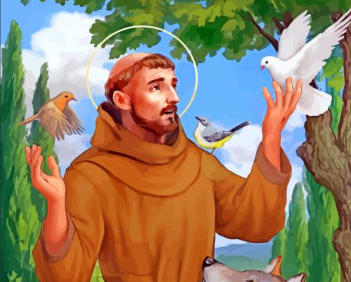
Few saints are as universally loved as Francis of Assisi. Atheists quote him, gardeners put his statue among their roses, popes take his name, and environmentalists claim him as a patron. Yet the familiar image of a gentle man surrounded by birds can hide the radical figure underneath: a wealthy merchant’s son who stripped himself naked in a public square, kissed the sores of lepers, crossed enemy lines during a crusade, and bore on his body wounds resembling those of Christ.
This article traces the real Francis as far as the sources allow: the man, the movement he founded, the legends that gathered around him, the controversies that shadowed his order, and the reasons he still speaks to a world that seems very different from thirteenth-century Italy, and in some ways is not.
Historical Background and Early Life
A Merchant’s Son in Umbria
Francis was born around 1181 or 1182 in Assisi, a hill town in central Italy’s Umbria region. He was baptized Giovanni, but his father, the prosperous cloth merchant Pietro di Bernardone, was away in France on business at the time of his birth and, on returning, took to calling him Francesco, “the Frenchman.” Some sources suggest the name reflected his father’s love of France and the trade that made the family rich. His mother, Pica, is traditionally described as a gentle woman, possibly of French origin, though evidence about her is thin.
The family belonged to the rising merchant class, the new money of the medieval Italian city. Pietro dealt in fine fabrics, traveled to the great trade fairs of Champagne, and expected his son to inherit the business. Francis grew up with money, fashionable clothes, and no need to worry about the future.
A World in Transition
Francis was born into a century of dramatic change. Europe’s economy was shifting from a land-based feudal order to a money-based urban one. Towns like Assisi were growing, guilds were forming, and a new class of merchants was challenging the old landed nobility. These tensions were not merely economic. In 1198, when Francis was a teenager, the townspeople of Assisi rose up and attacked the fortress that symbolized imperial and aristocratic control, an episode that forced many noble families to flee to rival Perugia. Soon Assisi and Perugia were at war.
Politically, Italy was caught between two great powers: the Holy Roman Emperor and the papacy. The Church was at the height of its institutional strength under Innocent III, who claimed extraordinary authority over kings, yet it was also criticized for wealth, worldliness, and clerical corruption. Popular movements demanding a return to the simplicity of the Gospel were springing up. Some, like the Waldensians, were eventually condemned as heretics. Others, like the Cathars in southern France, rejected Catholic teaching entirely and were targeted by a brutal crusade. The question of how to live a truly evangelical life without leaving the Church was one of the burning issues of the age.
The Crusades also shaped the mental landscape. The Fourth Crusade, launched in 1202, ended with the sack of Christian Constantinople in 1204, a scandal that shocked many. The dream of holy war and chivalric glory was powerful, but its reality was increasingly ugly.
Youth, Ambition, and Chivalry
By his own later admission, Francis lived his early years in worldly style. His first biographer, Thomas of Celano, writing within a few years of his death, describes a charming, generous, extravagant young man who led the revels of Assisi’s youth, loved songs and fine clothes, and dreamed of becoming a knight. Troubadour songs of chivalry and courtly love filled his imagination, and he was fascinated by the French language and romance.
Francis’s ambitions led him to war. In about 1202 he fought for Assisi against Perugia and was captured at the Battle of Collestrada. He spent roughly a year as a prisoner, perhaps because his family’s wealth made him worth ransoming. Captivity seems to have shaken him, and shortly after his release he fell seriously ill. When he recovered, the pleasures that once thrilled him seemed hollow.
Spiritual Awakening and Path to Sainthood
The Failed Knight
Still hoping for glory, Francis prepared in about 1205 to join a military expedition to southern Italy. On the way, at Spoleto, he had a dream, or an inner experience, in which a voice asked him whether it was better to serve the master or the servant. Understanding that he had chosen the wrong lord, he turned back to Assisi. To his friends he seemed to have lost his edge. In this period he began to seek solitude, praying in caves and wondering what God wanted from him.
The Leper
The most famous turning point came on the road. Francis had always been repelled by leprosy, as were most people of his time, who feared both the disease and the sufferers, who were forced to live outside towns. One day, as he later recalled in his Testament, he met a leper and, instead of recoiling, dismounted, gave him money, and kissed his hand. He wrote that what had seemed bitter to him was turned into sweetness of body and soul. This simple act of embrace was the hinge of his conversion. After it, he began to serve in leper hospitals, and his understanding of what it meant to follow Christ shifted from conquest to compassion.
The Voice at San Damiano
Around 1205 or 1206, while praying before a Byzantine-style crucifix in the ruined chapel of San Damiano outside Assisi, Francis heard Christ say, “Francis, go and repair my house, which, as you see, is falling into ruin.” He took it literally. He sold some of his father’s cloth, and perhaps a horse, to fund the rebuilding of the chapel. Only later did he understand that the “house” was the whole Church.
The Break with His Father
Pietro, furious at the theft and humiliated by his son’s behavior, dragged him before the bishop of Assisi. In the public hearing that followed, Francis did something that has echoed through history: he stripped off his clothes, handed them to his father along with the money, and declared that from now on he would say only “Our Father who art in heaven.” The bishop covered him with his cloak. Francis had renounced family, inheritance, and the economic order that had shaped him.
Hearing the Gospel
In about 1208, while attending Mass at the small chapel of the Portiuncula, Francis heard the Gospel passage in which Jesus sends out his disciples with no money, no bag, no second tunic. He took it as addressed to him personally. He discarded his shoes and staff, put on a rough tunic tied with a cord, and began to preach repentance and peace. His mission was clear: to live the Gospel literally.
Followers soon gathered, first Bernard of Quintavalle, a wealthy man, then Peter Catani and others. They shared one aim: to follow the poor Christ with nothing of their own. Like many converts, Francis struggled with doubt and fear. Early accounts describe a young man unsure of where his path would lead, aware of how strange he looked to his neighbors, who sometimes mocked and stoned him.
Major Works, Teachings, and Contributions
A New Way of Religious Life
Francis’s greatest contribution was not a book but a movement. Around 1209 he and his first companions traveled to Rome and obtained verbal approval from Pope Innocent III for a simple Forma Vitae, a brief rule built from Gospel texts. The Franciscans, or Friars Minor (“lesser brothers”), were to own nothing, work with their hands, beg only when necessary, serve the poor and the sick, and preach by example and word. Unlike monks, who lived in stable monasteries, the friars lived among the people in towns, an innovation that reshaped medieval religious life.
Francis insisted on the name “minor,” meaning lesser ones, deliberately choosing a posture of humility in a society preoccupied with rank. He also supported Clare of Assisi, who in 1212 left her wealthy family to follow his path and founded the Poor Clares, the women’s branch of the movement. A Third Order for laypeople followed, allowing men and women to live Franciscan ideals while remaining in their homes and trades.
Writings
Francis wrote little, but what survives is revealing. His Rule (the 1223 version approved by Pope Honorius III), his Testament (dictated near the end of his life), and a handful of letters and prayers show a man who preferred simplicity and fidelity to the Gospel over theological argument. Among his best-known works:
- The Canticle of the Creatures (also called the Canticle of Brother Sun), composed around 1225, is a hymn in the Umbrian vernacular praising God through Brother Sun, Sister Moon, Brother Wind, Sister Water, Brother Fire, and Mother Earth. It is among the earliest major works of Italian literature.
- The Praises of God and the Blessing for Brother Leo, a short text written after a period of spiritual trial, expresses his intense devotion in a few lines. The famous Prayer of Saint Francis (“Lord, make me an instrument of your peace”) is often attributed to him but first appeared in print in the early twentieth century and is not his.
- Admonitions, short spiritual sayings about humility, obedience, and poverty.
A Theology of Incarnation and Creation
Francis was no academic theologian, but his spirituality carried deep theological weight. He focused on the humanity of Christ: the Child in the manger and the Man on the cross. At Greccio in 1223, he is said to have arranged a living nativity scene with a real ox and donkey, helping popularize the Christmas crèche. His devotion to the Eucharist was intense, and he insisted that priests be honored because they handled the Body of Christ.
His vision of creation was equally striking. For Francis, all creatures were siblings because all came from the same Creator, a view later scholars have connected to a distinctly Franciscan theology that emphasized God’s presence in the material world. Followers such as Bonaventure and Duns Scotus developed these instincts into sophisticated philosophy, including Scotus’s emphasis on the individuality of each creature and the primacy of Christ.
Peace and Encounter
In 1219, during the Fifth Crusade, Francis crossed into Egypt and, according to several sources, met Sultan al-Malik al-Kamil near Damietta. He was received courteously, and returned unharmed. Details of the conversation are lost and the accounts differ, but the meeting is widely considered a remarkable moment of peaceful encounter in an age of holy war. Some modern historians see it as an early example of interfaith dialogue, while others caution against reading modern ideas back into a thirteenth-century missionary effort. Either way, Francis went unarmed, which was itself a statement.
Miracles, Signs, and Supernatural Accounts
The Wolf of Gubbio
The most beloved legend appears in the Little Flowers of Saint Francis, compiled in the fourteenth century from earlier traditions. It tells of a fierce wolf terrorizing the town of Gubbio. Francis went out to meet it, made the sign of the cross, called it “Brother Wolf,” and persuaded it to stop attacking the villagers in exchange for being fed by them. The wolf placed its paw in his hand as a pledge and lived peacefully among the townspeople until its death.
Historians regard this as a later legend rather than an eyewitness account, but many interpret it symbolically: perhaps the “wolf” was a violent man or a feud-ridden faction that Francis tamed through peacemaking. In a violent, factional society, a man who could reconcile enemies was working a kind of miracle.
Preaching to the Birds
Another famous story, in Celano and Bonaventure, describes Francis speaking to a flock of birds and urging them to praise their Creator, who had given them feathers, freedom, and food. The birds, it is said, stayed to listen, and flew off in the form of a cross after he blessed them. The tale expresses his conviction that all creatures were capable of praising God, and it has become the central image of Franciscan spirituality.
The Stigmata
The most extraordinary claim about Francis is that in September 1224, while praying on Mount La Verna in Tuscany, he received the stigmata, wounds in his hands, feet, and side corresponding to those of the crucified Christ. According to Bonaventure’s account, he had a vision of a seraph, a winged figure bearing the form of a crucified man, and afterward found the marks on his body. Brother Elias, who announced his death to the order, described the wounds in a letter, and Brother Leo, his closest companion, is traditionally cited as a witness.
The stigmata are the first widely reported case of the phenomenon in Christian history, and they remain debated. Believers see them as a sign of Francis’s union with Christ. Skeptics suggest self-inflicted wounds, psychosomatic effects, or later embellishment, and note that Francis tried to hide the marks and that the earliest sources are not entirely consistent. The Church accepts the tradition and celebrates the event with a liturgical feast on 17 September, but it does not require belief in it as an article of faith.
Healings and Other Wonders
Early biographies attribute many healings to Francis during and after his life, including cures of illness and deformity, and reports of his ability to read hearts. After his death, claims of miracles at his tomb multiplied. As in the case of most medieval saints, these accounts mix testimony, devotional enthusiasm, and literary convention. Theologians generally distinguish between the core miracle of his transformed life, which is well attested, and the later reports, which vary in reliability.
Trials, Persecutions, and Controversies
Family and Social Rejection
Francis’s earliest trials were personal. His father disowned him, his townspeople mocked him as a madman, and in the early years the brothers were sometimes beaten and driven away. Their poverty and their refusal to take part in the economic life of the town struck many as an insult.
Illness and Interior Darkness
In his final years, Francis suffered physically. He contracted an eye disease, likely trachoma, picked up in the East, and eventually became almost blind. He endured painful treatments, including cauterization of his temples. He also suffered inwardly. Accounts speak of periods of spiritual desolation, in which he felt abandoned by God, and of deep distress at the direction of his order.
The Struggle Over Poverty
The greatest conflict of Francis’s life, and of the order’s history, was about poverty. As the movement grew from a handful of brothers to thousands, practical questions pressed: Could friars own books, which scholars needed? Could they have buildings for large communities? How were they to survive without property or money? Francis envisioned absolute simplicity. Others, including church leaders such as Cardinal Ugolino (the future Pope Gregory IX), believed some adaptation was necessary for the order to endure and to serve the Church.
While Francis was away in the East in 1219–1220, the brothers who had been left in charge introduced changes he found troubling. On his return he stepped down as head of the order, and later accepted a revised Rule in 1223 that was more juridical than his original vision. Some of his later writings, particularly the Testament, which urged that the Rule be observed without gloss, seem to bear the weight of this sorrow. Only a few years after his death, Pope Gregory IX declared that the Testament was not legally binding.
After Francis: The Spirituals and the Conventuals
The conflict outlasted him. One party, later called the Spirituals, insisted on strict poverty and appealed to Francis’s original intention. Another, the Conventuals, accepted a more moderate approach with property held in trust by others. The dispute grew bitter. In the early fourteenth century, it entangled the order with questions of papal authority and the poverty of Christ himself. Pope John XXII condemned the doctrine of Christ’s absolute poverty in 1323, and some rigorous Franciscans were persecuted, a few burned at the stake. The order that began as a movement of peace produced bitter infighting, a bleak irony. Eventually the family divided into separate branches, including the Observants and the Capuchins, who sought to return to a stricter simplicity.
Critics and Debates
Francis has also been criticized from different sides. Some historians have asked whether his radical poverty was impractical or even naïve, and whether he effectively ceded control of his movement to a papacy that tamed it. Others contend that his gentleness has been sentimentalized to the point where his harder edges, including his demanding asceticism, his severe treatment of his own body (which he later called “Brother Ass”), and his intense reverence for the clergy, have been airbrushed away. Some modern writers question whether his meeting with the Sultan represented genuine dialogue or a missionary strategy. These debates are part of the effort to see Francis as a real person of his time rather than a greeting-card saint.
Death, Canonization, and Posthumous Influence
Brother Death
By 1226 Francis was gravely ill and nearly blind. He was taken to Assisi, and, as his condition worsened, he asked to be carried to the Portiuncula, the little chapel where his movement had begun. According to tradition, he welcomed death by adding to his Canticle a verse praising “Sister Bodily Death,” and he asked to be laid on the bare earth. He died on the evening of 3 October 1226, at about forty-four years of age, as the brothers sang a psalm. Tradition says that larks, which are said to love the light, gathered over the roof as he died.
Rapid Canonization
The Church moved with astonishing speed. Pope Gregory IX, who had known Francis personally, canonized him on 16 July 1228, less than two years after his death, at Assisi. The following day Gregory laid the cornerstone of a great basilica in his honor. Thomas of Celano wrote the first official Life, and later Bonaventure produced the Major Legend (1263), which the order decreed should be the authoritative biography. In an attempt to restore unity, the order ordered older biographies destroyed, so that for centuries many early sources were lost, and only rediscovered in modern times.
The Tomb and the Basilica
Francis was buried in Assisi, but his body was secretly hidden for fear of theft, and its location was forgotten until it was rediscovered in 1818 after a long search. A crypt was later built to house the tomb. Today it lies in the Lower Basilica, a destination for pilgrims from all over the world.
A Legacy That Kept Evolving
Over the centuries, Francis’s image changed. Medieval Franciscans saw him as the “second Christ.” The Renaissance admired his humanity. Romantic writers adored his love of nature, and early twentieth-century scholars, such as the Protestant writer Paul Sabatier, whose 1894 biography was a sensation, presented him as a proto-reformer at odds with the institutional Church. Pope Pius XII named him patron of Italy together with Catherine of Siena in 1939. In 1979 Pope John Paul II declared him patron saint of ecology, and in 2013 the newly elected Pope Jorge Bergoglio took the name Francis, the first pope to do so, saying that he wanted a “Church that is poor and for the poor.”
Cultural, Artistic, and Global Impact
Symbols and Feast Days
Francis is typically shown in a brown or gray habit with a knotted cord of three knots, symbolizing poverty, chastity, and obedience. His other symbols include the stigmata, a skull, a dove or birds, a wolf, and the crucifix. His feast day is 4 October, the day after the anniversary of his death, which is observed in the Franciscan family as the Transitus, a ceremony remembering his passing. The Church also celebrates the Stigmata of Saint Francis on 17 September. Many animal shelters and churches hold Blessing of the Animals services on or around 4 October.
Art
Francis transformed Western art. Giotto’s fresco cycle in the Upper Basilica of Assisi, painted around 1295 to 1300, depicts scenes from his life with a new naturalism and emotion, and is often cited as a turning point toward the Renaissance. Other artists, including Cimabue, Bellini, El Greco, Zurbarán, and Caravaggio, painted him in ecstasy, in prayer, or in solitude. Giovanni Bellini’s Saint Francis in the Desert (c. 1480) shows him in a luminous landscape as if in dialogue with creation.
Literature and Music
The Canticle of the Creatures is a founding text of Italian literature, and Dante honored Francis in the Paradiso, describing his marriage to “Lady Poverty.” The Little Flowers has inspired readers for centuries. In the twentieth century, writers as varied as G.K. Chesterton and Nikos Kazantzakis wrote about him. Composer Olivier Messiaen wrote the opera Saint François d’Assise (1983), and Franz Liszt wrote piano pieces about the sermon to the birds. Franco Zeffirelli’s 1972 film Brother Sun, Sister Moon introduced him to a new generation. Hymns such as “All Creatures of Our God and King” draw on his Canticle.
Architecture and Place
The Basilica of Saint Francis in Assisi, a UNESCO World Heritage Site, holds both his tomb and some of Europe’s greatest frescoes. Franciscan churches, friaries, hospitals, and universities appear across the globe. The city of San Francisco takes its name from him through the Spanish mission founded there in 1776, and many other places, from Santa Fe to São Paulo, bear his name. Franciscan missionaries helped carry Christianity to the Americas and Asia, bringing with them both genuine care for the poor and, as scholars now acknowledge, complicated entanglements with colonial power.
The Franciscan Family
Today the Franciscan family includes the Friars Minor, Conventuals, and Capuchins, the Poor Clares, hundreds of congregations of sisters and brothers, and the Secular Franciscan Order. They work in education, health care, advocacy, and care for creation across the globe. The Franciscans have maintained custody of key Christian holy places in the Holy Land since the fourteenth century.
Modern Relevance and Lessons for Today
Care for Creation
In an age of climate change and mass extinction, Francis’s vision of all creatures as kin carries new urgency. Pope Francis’s 2015 encyclical Laudato Si’ takes its name from the Canticle and calls for an “integral ecology” linking care for the planet with care for the poor. Francis of Assisi shows that environmental concern is not merely a policy question but a spiritual posture of reverence.
Simplicity in a Consumer Culture
Francis was born into a prosperous culture and left it. His example challenges a world driven by consumption, status, and accumulation. His choice of poverty was not self-punishment but freedom: the less he owned, the less he feared. That insight speaks to anyone exhausted by the treadmill of buying and comparing.
Peacemaking and Dialogue
His walk across a battlefield to meet a Muslim ruler is often invoked in discussions of interfaith relations. In a polarized world, Francis shows the possibility of meeting someone across the divide with respect and without weapons. He did not abandon his own faith, but he refused to demonize the other.
Solidarity with the Marginalized
Francis’s embrace of the leper is a model for how to approach those society pushes aside: the homeless, the sick, the stigmatized. His movement did not simply give charity from a distance; it lived among the poor. His example asks hard questions about proximity and who we are willing to touch.
Renewal Within Institutions
Francis loved the Church, though it was flawed. He neither left it nor ignored its problems, but worked to renew it by example. In an age when many are disillusioned with institutions, religious and secular, his path suggests that reform begins with personal conversion, not just criticism.
Joy
Perhaps most striking is that Francis was known for joy. He called himself a “troubadour of the Lord” and sang even in suffering. For people facing illness, loss, or an uncertain future, his joy was not denial but trust.
Reflection and Practical Application
1. Simplify something. Choose one area of excess, such as clothes, subscriptions, or commitments, and reduce it. Notice what you gain in freedom and attention.
2. Approach the person you avoid. Francis’s turning point was moving toward what disgusted him. Identify a person or group you tend to avoid out of fear or discomfort, and take one small step toward understanding them: a conversation, a volunteer shift, a visit.
3. Spend time in creation. Take a walk without headphones. Observe a tree, a bird, a stream. Let it be a form of prayer or simply attention.
4. Be an instrument of peace. In a conflict at home or work, ask what would reconcile rather than win. Offer the first apology, or listen before responding.
5. Care for your local environment. Reduce waste, plant something, support a cleanup. Small actions are Franciscan when they come from reverence.
6. Serve those in need directly. Give time, not only money. Volunteer at a shelter, a hospice, a food bank, or a care home.
7. Practice gratitude. Write your own version of the Canticle: a list of the things in creation for which you are thankful, from the sun to a cup of tea.
8. Keep a sense of humor and joy. Do not let seriousness harden into grimness. Sing, laugh, and celebrate.
9. Start where you are. Francis began by repairing a ruined chapel, not by reforming Christendom. Ask what small thing in front of you needs mending.
A simple weekly practice: read the Canticle of the Creatures slowly on Sunday, choose one creature or element to give thanks for each day, and end the week with one concrete act of service.
Closing Summary
Francis of Assisi began as a young man who wanted to be admired and ended as one who wanted only to be faithful. He left a comfortable home, embraced a leper, stood naked before a bishop, and walked into the world with nothing, and discovered there a freedom that has fascinated people ever since. He did not set out to found an order, write a masterpiece, or change history. He set out to follow Christ, and the rest happened as a consequence.
His life was not simple or serene. He was misunderstood by his family, burdened by the growth of his movement, tormented by illness, and saddened by disputes among his brothers. Yet he composed a song of praise near the end, when he was blind, in pain, and sure that his dream was slipping away. That may be the deepest lesson of all: joy that does not depend on circumstances.
Eight centuries on, we are still learning what he meant by the words “repair my house.” The house is the Church, but it is also the planet, our neighborhoods, our families, and our inner lives. The task is endless, and it begins with a single act of humility. Francis invites us to take it up, not with grim determination, but with open hands, singing.