
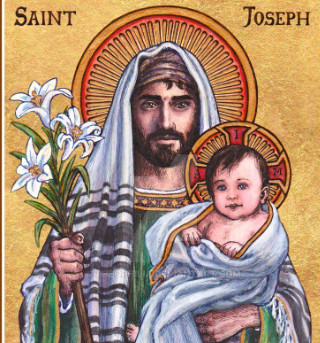
Saint Joseph, the husband of Mary and the earthly father of Jesus, is the most silent major figure in the Christian story. Across four Gospels, not one word he speaks is recorded. He appears in a handful of scenes, takes decisive action in each, and then disappears from the narrative as quietly as he entered it. Yet over two thousand years he has become the patron of the universal Church, of fathers, workers, immigrants, and the dying, and one of the most prayed-to saints in the Catholic world.
This article is about Joseph the carpenter of Nazareth, not Joseph of Arimathea, the wealthy disciple who buried Jesus. It traces what history and Scripture can say about him, what tradition and devotion added, and why a man of so few words continues to speak to so many people.
Historical Background and Early Life
A Descendant of David in an Occupied Land
Almost everything we know about Joseph comes from two Gospel accounts, Matthew and Luke, and they agree on the essentials: Joseph was a man of the house of David, betrothed to Mary, and living in Nazareth, a small village in Galilee. Matthew traces his ancestry through a royal line, giving the father of Joseph as Jacob. Luke’s genealogy names Heli. The discrepancy has produced centuries of debate. Some ancient writers suggested the two lists reflect a levirate marriage, others that one traces Joseph’s line and the other Mary’s, and many modern scholars see the genealogies as theological statements about Jesus’ identity rather than precise family records. What both agree on is the point that mattered most: through Joseph, Jesus is a son of David, heir to Israel’s messianic hope.
Nazareth and the Craft of a Tekton
Joseph is called a tekton in Greek, a word usually translated “carpenter” but better understood as a builder or craftsman who worked with wood and possibly stone. Nazareth was tiny, probably a few hundred inhabitants, but it lay only a few miles from Sepphoris, a city that Herod Antipas rebuilt on a grand scale during Jesus’ youth. Many historians suspect that skilled tradesmen from the surrounding villages found work there, though the Gospels do not say so.
A tekton was no aristocrat, but he was no pauper either. He had a trade, tools, and a reputation. Still, his world was precarious. Rome’s occupation brought heavy taxation, and a bad harvest or a lost commission could push a family toward debt. When Joseph and Mary later present Jesus at the Temple, they offer two turtledoves, the sacrifice the law allowed for those who could not afford a lamb. That small detail tells us Joseph lived near the edge of poverty.
The Political Weather
Joseph’s era was dangerous. Herod the Great, a brilliant builder and a paranoid tyrant, ruled until about 4 BCE. Ancient historians such as Josephus record his willingness to kill rivals, including members of his own family. After his death the kingdom was split among his sons, with Archelaus ruling Judea so brutally that Rome eventually removed him. Messianic and revolutionary movements flared across the land, and Rome answered with crosses.
This is the world that shaped Joseph: a devout Jewish man in a village under foreign rule, schooled in Torah through synagogue and household observance, living with the expectation that God would one day act. He did not expect that God would act through his own family.
Spiritual Awakening and Path to Sainthood
A Righteous Man in a Crisis
Joseph’s story begins with a crisis. Matthew tells us that Mary, betrothed to Joseph, was found to be with child before they lived together. In Jewish custom, betrothal was a legally binding commitment, and the law treated this situation as a grave matter. Joseph had options. He could have publicly denounced her, which under strict reading of the law carried severe penalties. He could have quietly drawn up a bill of divorce. Matthew describes him as a “righteous man” who was unwilling to expose Mary to shame, and so he resolved to dismiss her quietly.
Scholars and theologians have read this moment in two ways. The more common modern reading is that Joseph assumed Mary had been unfaithful and chose mercy over the harsher letter of the law. An older tradition, found in some Church Fathers and later medieval writers, suggests that Joseph already sensed something holy was happening and felt unworthy to take part in it. Either way, the portrait is of a man torn between obligation and compassion, deciding, with no one to advise him, to err on the side of kindness.
The Dream
Then comes the turning point. In a dream an angel addresses him as “Joseph, son of David” and tells him not to fear taking Mary as his wife, because the child within her is from the Holy Spirit. Joseph wakes and does as he was told. There is no negotiation, no demand for proof, no recorded speech. His response is simply obedience, and it changes his life.
This is the pattern of Joseph’s spirituality. Matthew records four dreams in all: the first to accept Mary, the second to flee to Egypt, the third to return, and the fourth to settle in Galilee rather than Judea. Each time he acts at once, even when action means leaving his home, his trade, and his security in the middle of the night.
The Inner Life We Cannot See
We should be honest about what we do not know. The Gospels give us nothing about Joseph’s prayers, his doubts, or his private struggles. But the situation itself suggests them. Here was a man whose plans for an ordinary marriage and a quiet life were overturned in a single night. He faced gossip in a village where everyone knew everyone, the prospect of raising a child who was not biologically his, and the weight of a vocation he could not fully understand. His holiness did not come from visions of glory. It came from saying yes, repeatedly, to a role that kept asking more than he expected.
Major Works, Teachings, and Contributions
A Theology Written in Actions
Joseph left no letters, sermons, or sayings. His “teaching” is entirely biographical, and the Church has built a surprising amount of theology on it.
First, he gave Jesus his legal and social identity. In a patriarchal culture, a child needed a father to belong. By naming the child Jesus, as the angel commanded, Joseph formally adopted him into the house of David. The Gospels call Jesus “the son of Joseph” in the voices of neighbors who knew the family, and Luke notes with careful phrasing that he was “supposed” to be Joseph’s son. That small word captures the mystery: Joseph was a true father in every way that human love and responsibility can make one, without being the biological father.
Second, he protected the family. The flight into Egypt, a journey of perhaps hundreds of miles with a young mother and infant, makes Joseph a refugee. He leaves by night, lives as a foreigner, and returns only when it is safe. Without him the story ends in Bethlehem.
Third, he formed a child. The Gospels give us only one scene from Jesus’ childhood, but Luke adds a summary: Jesus grew in wisdom and stature, and was obedient to his parents. A boy raised in a carpenter’s household learned a trade, learned the Scriptures, learned to pray the Psalms, and learned what fatherly love looks like. Jesus’ later habit of addressing God with the intimate word “Abba” has led many to wonder what human experience of fatherhood stood behind it.
Josephology: The Theology of Joseph
For centuries Joseph was a background figure in theology. That changed in the late Middle Ages and accelerated in the modern period, giving rise to what is sometimes called Josephology. Theologians reflected on his role as “guardian of the Redeemer,” on his virginal marriage (a tradition developed by Augustine and others, holding that Joseph and Mary lived in chaste partnership), and on his dignity as the head of the Holy Family.
Modern papal teaching has expanded this. Pope John Paul II’s 1989 apostolic exhortation Redemptoris Custos (“Guardian of the Redeemer”) presented Joseph as a model of faith and work. Pope Francis’s 2020 apostolic letter Patris Corde (“With a Father’s Heart”) described him as a beloved, tender, obedient, and accepting father, one of creative courage, a working man, and a father “in the shadows.” These documents treat Joseph’s silence not as absence but as a form of spiritual strength.
The Dignity of Work
One of Joseph’s most far-reaching contributions is indirect: he sanctified ordinary labor. By making the Son of God’s foster father a craftsman, the Gospel tradition gave manual work a place in sacred history. In 1955 Pope Pius XII established the feast of Saint Joseph the Worker on 1 May, responding to the secular May Day celebrations of the labor movement and affirming that work has dignity and that workers have rights.
Miracles, Signs, and Supernatural Accounts
Miracles in His Life
Joseph performed no miracles that Scripture records. The supernatural enters his story as something that happens to him: the angelic dreams, the conception of Jesus, and the guidance that steers the family away from danger. The Gospels also describe the circumstances around Jesus’ birth, including the shepherds’ visit, and a later episode when Jesus, at twelve, remains behind in the Temple at Jerusalem, and Joseph and Mary search anxiously for three days before finding him. That scene captures Joseph’s humanity as nothing else does: the panic of a father who has lost a child.
Apocryphal Tales
Later Christians were curious about what the Gospels left out, and a group of non-canonical writings filled in the blanks. The second-century Protoevangelium of James portrays Joseph as an elderly widower chosen by a sign from among the widowers of Israel to be Mary’s guardian, a story that includes the tale of his staff blossoming. The much later History of Joseph the Carpenter, a text from perhaps the fifth to seventh century, narrates Joseph’s long life and death in vivid detail, claiming he died at 111 with Jesus and Mary at his bedside.
Scholars regard these works as pious legend rather than history, and the Church does not treat them as authoritative. But they shaped imagery and devotion for centuries, including the long-standing artistic portrayal of Joseph as an old man and the belief that he died a peaceful death in the presence of Jesus and Mary.
Intercession: Teresa of Ávila and Brother André
The “miracles” most associated with Joseph are reports of answered prayer. The most famous early witness is Saint Teresa of Ávila, the sixteenth-century Carmelite reformer, who wrote that she had never asked Joseph for anything without receiving it, and who urged others to try his intercession for themselves. She named her first reformed convent in his honor in 1562.
In the modern era, the great Josephite figure is Brother André Bessette, a humble doorkeeper at a school in Montreal who, in the early twentieth century, became known for his devotion to Joseph and for the healings people attributed to his prayers. He raised funds for a chapel that grew into Saint Joseph’s Oratory, one of the largest churches in the world, drawing millions of pilgrims. Brother André was canonized in 2010.
Legends and Folk Belief
Popular tradition has added many stories. In Sicily, the tradition of the “Saint Joseph’s Table” is said to originate from a medieval famine in which villagers prayed to Joseph for relief and were answered with rain. Each year on 19 March, communities prepare lavish altars of food, especially fava beans and bread, and give the meals to the poor. In Santa Fe, New Mexico, the Loretto Chapel’s famous spiral staircase is, according to local legend, the work of a mysterious carpenter who appeared in answer to the nuns’ prayers, built it, and vanished without payment. Many take him to be Joseph. This is folklore, not documented history, but it shows how devotion flows toward him.
How Theologians Weigh These Accounts
The Church draws careful distinctions. The dreams and the virginal conception are part of the Gospel witness, which believers accept as revelation. Apocryphal stories are treated as pious tradition at best. Reports of answered prayers are considered matters of personal testimony and are not required articles of faith. Skeptics see the same accounts as examples of the psychological power of devotion. Believers respond that a saint whose life was defined by trust is exactly the sort of figure to whom people turn in need.
Trials, Persecutions, and Controversies
The Trials Within the Story
Joseph’s trials are written into the Gospels. There is the initial scandal of Mary’s pregnancy. There is the journey to Bethlehem for a census (a detail historians debate, since Luke’s reference to the governor Quirinius is hard to reconcile with Matthew’s account of Herod’s reign). There is the birth in a borrowed space because, in Luke’s phrase, there was no room at the inn. And there is the terror of Herod’s massacre of the infants, which sends the family fleeing into exile. Though the slaughter is not independently attested outside Matthew, it fits what we know of Herod’s brutality.
The Brothers of Jesus
One long-running controversy concerns the “brothers and sisters” of Jesus mentioned in the Gospels. Who were they? In the fourth century, Epiphanius proposed that they were Joseph’s children from a previous marriage, which fit the tradition of an older Joseph. Jerome argued they were cousins. The Catholic and Orthodox traditions generally uphold Mary’s perpetual virginity and therefore reject the idea that Joseph and Mary had other children. Many Protestant scholars read the text more plainly, as Jesus’ younger siblings. The debate is unresolved, and it touches how Joseph is imagined: an elderly widower, a young husband, or the father of a larger household.
The Late Rise of His Cult
A subtler controversy is the question of why veneration of Joseph took so long to flourish. In the early centuries, the church feared that attention to Joseph might undermine teaching about the virginal conception, and Joseph’s role was kept modest. Eastern Christians honored him early, but in the West his cult grew slowly. The theologian Jean Gerson, in the early fifteenth century, campaigned vigorously for a wider feast, and preachers such as Bernardino of Siena promoted devotion to him. Critics worried about exaggeration and about teachings that placed Joseph too close to Mary and Jesus. Even today, some Protestant traditions are uneasy with the scale of Catholic devotion to saints in general.
Debates Over His Image
Even the artistic image of Joseph has been contested. For centuries painters showed him as old, bald, and weary, a figure at the margin. Critics later argued this diminished his role, and Baroque artists began to portray him as younger, stronger, and more central. This is not just an aesthetic matter. It reflects how a culture understands fatherhood, authority, and holiness.
Silence as a Problem
Finally, there is a modern challenge: Joseph’s silence. Some contemporary readers see him as a figure who exemplifies the passive male, or who is used to valorize quiet submission. Others argue that the Gospels portray him as decisive, protective, and courageous, a man who acts when it counts. The tension between those readings is part of why he remains a living figure.
Death, Canonization, and Posthumous Influence
The Unrecorded Death
The Gospels do not record Joseph’s death. His last appearance is the Temple scene when Jesus is twelve. By the time Jesus begins his public ministry, Joseph is absent: he is not at the wedding at Cana, and when Jesus is dying on the cross, he entrusts Mary to the beloved disciple, which strongly implies Joseph was no longer alive. Tradition therefore holds that Joseph died before Jesus’ public ministry, with Jesus and Mary at his side. That idea, drawn largely from the apocryphal History of Joseph the Carpenter, is the root of his title as patron of a happy death.
There are no reliably documented relics of Joseph, and the Church makes no claim to possess his body. His tomb is a gap in the record.
A Sainthood Without a Formal Process
Joseph was never “canonized” in the sense of a formal investigation like those that exist today. Early Christian sainthood grew from popular veneration. The Eastern churches honor him in the Sunday after Christmas, alongside David and James, and Coptic tradition has its own commemoration. In the West, his feast on 19 March begins to appear in calendars from about the ninth century and spread gradually. Pope Sixtus IV included it in the Roman liturgy in 1479, and Pope Gregory XV made it a holy day of obligation in 1621.
The Great Expansion of Devotion
The sixteenth and seventeenth centuries were a turning point. Teresa of Ávila’s writings, the Carmelite and Jesuit movements, and the Spanish and French royal courts all promoted Joseph. In 1624 he was named patron of Canada, then New France. In 1870, Pope Pius IX declared him Patron of the Universal Church, and in 1889 Leo XIII’s encyclical Quamquam Pluries urged the faithful to turn to him in the trials of the age.
More recent popes have deepened his place in the liturgy. In 1962 John XXIII added Joseph’s name to the Roman Canon of the Mass. In 2013 Pope Francis extended that to the other Eucharistic Prayers. In December 2020, Francis proclaimed a Year of Saint Joseph to mark the 150th anniversary of the 1870 declaration. Francis has spoken openly of his own devotion, keeping a small statue of the sleeping Joseph and placing written prayers beneath it.
Cultural, Artistic, and Global Impact
Symbols and Feast Days
Joseph’s most familiar symbol is the lily, representing purity, and the carpenter’s tools: the saw, the square, the plane. He is also shown with a flowering staff, drawn from the apocryphal story, and often with the child Jesus on his arm or at his side. His principal feast is 19 March, and the feast of Saint Joseph the Worker falls on 1 May. In several countries, including Spain, Italy, and Portugal, 19 March doubles as Father’s Day. He is the patron of fathers, carpenters, workers, immigrants, travelers, house-hunters, families, and the dying, as well as of the Church and of several nations.
Art
Artists have found Joseph a rich and tender subject. Medieval and Renaissance painters placed him at the edge of nativity scenes, often dozing or leaning on a staff. Later artists brought him forward. Georges de La Tour’s Joseph the Carpenter (c. 1642) shows a boy holding a candle for his father as he works, the light glowing on both faces, and it is one of the most intimate depictions of fatherhood in European art. Murillo’s Holy Family scenes, Guido Reni’s paintings, and countless altarpieces portray him as a strong, loving presence. Images of the flight into Egypt, with Joseph leading the donkey through a dark landscape, capture his role as protector.
Architecture and Place
Joseph’s name is borne by cathedrals, parishes, schools, hospitals, and religious orders worldwide. Saint Joseph’s Oratory in Montreal, with its enormous dome overlooking the city, is among the most visited shrines in North America. Antoni Gaudí’s Sagrada Família in Barcelona is dedicated to the Holy Family, and Joseph appears in its sculptural program. Religious congregations such as the Josephites and the Sisters of Saint Joseph have run schools, missions, and hospitals on every continent, often serving immigrants and the poor.
Music, Literature, and Folk Tradition
Joseph appears in Christmas carols, among them the old German song whose refrain begs “Joseph, dearest Joseph mine” to help rock the cradle, and in nativity plays and crib scenes that trace back to Saint Francis’s famous Christmas celebration at Greccio in 1223. His feast inspires some of Europe’s most distinctive food traditions, including the Sicilian altars of bread and the Italian pastries called zeppole eaten on 19 March. A curious folk practice in the English-speaking world is burying a small Joseph statue in the yard of a house that is for sale, in hope of a quick sale, a custom that is more popular than doctrinal but shows his reputation as a helper in practical matters.
Devotional Practices
Catholic life includes a novena (nine days of prayer) before his feast, the Litany of Saint Joseph, and the traditional Month of Saint Joseph in March. Many Catholics also keep Wednesdays as a day of devotion to him. Prayers such as the Memorare to Saint Joseph and Pope Leo XIII’s prayer to Joseph ask for his protection over families and the Church.
Modern Relevance and Lessons for Today
Fatherhood Beyond Biology
In an age of blended families, adoptions, and absent fathers, Joseph offers a profound model. His fatherhood was a matter of choice, presence, and care, not blood. Anyone who has raised a child they did not bear, stepparents, foster carers, mentors, and teachers, will recognize his vocation. He shows that love expressed in daily responsibility is as real as any biological bond.
Quiet Leadership
Our culture prizes loud leadership, charismatic voices, and self-promotion. Joseph exemplifies a different model: leadership through reliability. He is the person who is there at the cost of his own plans, who acts decisively without demanding credit. Many of the people who hold families, workplaces, and communities together are like him, doing essential work that never makes headlines.
Migrants and Refugees
At a time when millions are displaced by war, persecution, and poverty, the image of Joseph fleeing in the night with a mother and child carries unavoidable force. Church leaders have repeatedly invoked the Holy Family as refugees. The story asks believers to see in every displaced family a reflection of Joseph’s, and to treat welcome as a spiritual obligation.
Work, Dignity, and Economic Justice
Joseph the Worker speaks to modern anxieties about precarious employment, automation, and exploitation. His story affirms that labor is not just a means of survival but a vehicle of human dignity, and that workers deserve fair treatment. It also challenges the opposite temptation: to define ourselves entirely by productivity or status.
Mercy Over Rigidity
In his first crisis, Joseph chose compassion over the harshest application of the law. That instinct is a counterweight to a culture quick to condemn, shame, and cancel. His example suggests that being “righteous” and being merciful are not opposites.
Trust in Uncertainty
Joseph never saw the full picture. He acted on partial light. For people facing job loss, illness, or an unclear future, his story suggests that faith is often less a matter of certainty than of taking the next faithful step.
Reflection and Practical Application
1. Do the next right thing. Joseph rarely had a long-term plan, only the next step. When you are overwhelmed, identify the one action that is clearly right and take it.
2. Choose mercy first. Before you react to someone’s failure, ask what a merciful response would look like. Joseph’s first instinct was to protect, not to punish.
3. Serve without needing credit. Pick one task this week that supports someone else and requires no recognition: fixing something, helping with a move, doing a thankless chore.
4. Show up for the people in your care. Whether you are a parent, relative, mentor, or friend, presence is the greatest gift. Put down your phone, take the walk, attend the event.
5. Honor your work. Approach your job, whatever it is, as a place where you can practice care, honesty, and craftsmanship. Offer it up, in religious language, or at least do it well.
6. Welcome the stranger. Find a concrete way to support refugees, migrants, or newcomers in your community, through volunteering, donating, or simply offering friendship.
7. Cultivate silence. Joseph’s inner life was lived in quiet. Set aside ten minutes a day without noise or screens and notice what surfaces.
8. Pray through him. In the Catholic tradition, a simple practice is to pray a short prayer to Joseph each morning, asking for help to protect and provide for those in your care, and to pray especially for those who are dying.
A simple weekly rhythm: read Matthew 1:18-25 and 2:13-23 slowly, reflect on a decision you are facing, and ask what a faithful and merciful response would look like.
Closing Summary
Joseph is the saint of what happens offstage. He is the one who stood beside Mary when her situation looked scandalous, who carried the child through the dark to safety, who taught him a trade and, most likely, how to pray. He worked, protected, and provided, and then slipped from the story at the point when the public drama began.
For centuries, the Church barely noticed him. Then, slowly, believers began to realize how much rested on his shoulders. Without his yes, there is no home for the Savior, no escape from Herod, no childhood in Nazareth. Teresa of Ávila trusted him with her reforms. Brother André trusted him with the sick. Popes have entrusted the entire Church to him, and countless ordinary people have trusted him with their families, their jobs, and their last hours.
What he teaches is not found in a sermon but in a posture: attentive, obedient to what is good, tender toward the vulnerable, steady in the face of fear. In a noisy age, that example is a quiet rebuke and an invitation. Greatness, in his story, is not measured by how many words we speak or how many people notice us, but by how faithfully we guard what has been entrusted to us.
If you ever feel that your work goes unseen, that your care for others is taken for granted, or that you are a minor character in someone else’s story, remember Joseph. The Gospels say nothing of what he said, but they show what he did, and it was enough to help change the world.