
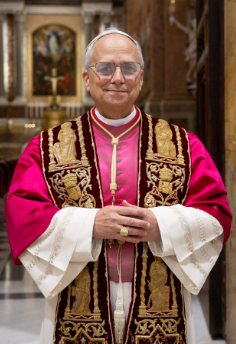
The Pope’s February 2026 address to Rome’s clergy raises profound questions about authenticity, spiritual connection, and what it means to truly preach the Gospel in the age of artificial intelligence.
By Staff Writer | March 5, 2026
In a closed-door dialogue with clergy from the Diocese of Rome on February 19, 2026, Pope Leo XIV delivered a message that cut through the noise of modern technological debates with the precision of someone who has spent years thinking carefully about both faith and the future. His warning was simple, direct, and, to many observers, long overdue: priests should resist the temptation to use artificial intelligence to write their homilies.
The Pope’s words, later published by Vatican News, were not those of a technophobe or a reactionary. Leo XIV — the Chicago-born former Cardinal Robert Francis Prevost, the first American to lead the Catholic Church — has demonstrated a sophisticated and nuanced understanding of technology’s role in modern society since the very first days of his pontificate. He chose his papal name, in part, in honor of Pope Leo XIII, whose landmark 1891 encyclical Rerum Novarum addressed the social upheaval of the first industrial revolution. Pope Leo XIV sees AI as the defining challenge of the current era, and he is engaged with it seriously.
Which is precisely why his warning about AI-generated sermons deserves to be taken seriously — not just by Catholic priests, but by anyone thinking about the intersection of human authenticity, spiritual life, and the growing role of technology in our most intimate acts of communication.
“To give a true homily is to share faith. Machines will never be able to share faith.” — Pope Leo XIV
What the Pope Actually Said
The setting of the Pope’s remarks is worth noting. This was not a press conference or a formal statement — it was a closed-door question-and-answer session with priests from the Rome Diocese, a gathering organized by Cardinal Baldo Reina. Four priests, representing four different age groups, were selected to ask the Pope questions. The fact that the Vatican later published the exchange signals that the Pope wanted his words to travel beyond that room.
On the subject of artificial intelligence and preaching, the Pope was characteristically direct. He urged the clergy to resist what he called “the temptation to prepare homilies with Artificial Intelligence.” His reasoning went to the heart of what preaching is supposed to accomplish: the sharing of lived faith. Machines, he argued, would never be capable of that.
He also invoked a striking analogy from human physiology: “Like all the muscles in the body, if we do not use them, if we do not move them, they die. The brain needs to be used, so our intelligence must also be exercised a little so as not to lose this capacity.” It was not just a theological point — it was a cognitive and intellectual one. Relying on AI to do our thinking, he suggested, atrophies the very faculties we need to think deeply about faith.
The Pope went further, insisting that parishes and congregations want to encounter the authentic faith of their priest — not a polished piece of generated text. “People want to see your faith, your experience of having known and loved Jesus Christ,” he said. The homily, in this framing, is not merely an information-delivery mechanism. It is a personal testimony.
The Deeper Theological Case
The Pope’s theological argument is grounded in a long tradition of Christian thought about the relationship between words and the person who speaks them. In Christian theology, the Word of God — the Logos — is not an abstract text but a person: Jesus Christ. The Gospel of John opens with the declaration that “the Word became flesh and dwelt among us.” This incarnational logic has always shaped Christian understandings of preaching.
A homily, in Catholic tradition, is not a lecture or an essay. It is a form of witness. The priest stands before the congregation not just as an instructor but as someone who has wrestled with the Scripture, prayed over it, and found in it meaning for the specific community gathered before him. The homily is supposed to emerge from the priest’s own encounter with God. That is not a task that can be outsourced.
The concern is not merely that AI-generated sermons might be inaccurate or theologically unsound — though that risk exists. The deeper concern is that they would be inauthentic. A congregation hearing a homily has a right to expect that what is being said comes from somewhere real: from the preacher’s own faith, doubt, struggle, and hope. When that expectation is violated — when the words have been assembled by an algorithm rather than shaped by a human soul — something essential is lost, even if no one in the pew knows the difference.
Pope Leo himself put it plainly: “If we can offer a service that is inculturated in the place, in the parish where we are working” — meaning rooted in the specific community, its particular joys and sorrows, its unique cultural context — then that is what makes preaching alive. No language model, however sophisticated, has sat with a dying parishioner, or counseled a couple on the brink of divorce, or stood in the parish hall serving soup on a cold winter morning. That lived knowledge is what gives a homily its power.
“Study in our life must be permanent, continuous. When I hear someone tell me they have not opened a book since leaving the seminary — how sad!” — Pope Leo XIV
A Contradiction at the Vatican?
Critics have been quick to point out what looks like a tension in the Vatican’s position. In the same period that Pope Leo XIV was warning priests against AI sermon-writing, the Vatican was unveiling an AI-powered translation system capable of rendering liturgical celebrations at St. Peter’s Basilica into up to 60 languages in real time. Is it not inconsistent to embrace AI for translation while rejecting it for preaching?
The answer, on reflection, is no — and the distinction the Pope is drawing is an important one. Translation is, at its core, a technical task: the goal is to render meaning accurately from one language to another. AI systems have proven remarkably capable at this, and using them to make the liturgy accessible to more people around the world is an extension of the Church’s universal mission.
Preaching is something fundamentally different. It is not a translation task. It is an act of witness, of relationship, of pastoral care. The homily is the moment in the Mass when a human being stands before other human beings and says, in effect: this is how the Gospel speaks to me, to us, here, now. That is irreducibly personal. No improvement in AI capability will change the fact that the congregation is gathered to hear from a person, not a program.
The Pope’s distinction is consistent with a broader principle in Catholic social teaching: technology should serve human flourishing, not replace the distinctly human activities that make life meaningful. The Rerum Novarum tradition that Leo XIV explicitly invokes has always insisted that workers — and, by extension, all people — cannot be reduced to their productive function. There are dimensions of human existence that must remain human.
The Social Media Warning
Alongside his words on AI, the Pope also addressed the seductions of social media — and the two warnings are deeply connected. He cautioned priests against the illusion that accumulating likes and followers on platforms like TikTok constitutes genuine spiritual engagement or ministry. “It is not you,” he said plainly. “If we are not transmitting the message of Jesus Christ, perhaps we are mistaken, and we must reflect very carefully and humbly about who we are and what we are doing.”
Both AI-generated sermons and social-media performance anxiety reflect the same underlying temptation: to substitute metrics for meaning, to mistake the appearance of impact for the reality of it. A priest who delegates his homily to ChatGPT and then obsesses over whether his TikTok sermon clips go viral has, in a very real sense, lost the plot. The goal of ministry is not reach or engagement — it is encounter, transformation, and the patient work of accompanying people through their lives.
The Pope’s warning about social media is also a warning about the performative nature of so much contemporary religious expression. Authenticity — a word much abused in digital culture — requires, in the Pope’s vision, not a carefully curated online persona, but a life of genuine prayer, real relationships, and honest engagement with the messy reality of people’s lives.
The Intellectual Responsibility of the Preacher
What makes the Pope’s address particularly compelling is that it is not simply a negative warning. Alongside the cautions about AI and social media, Leo XIV issued a positive challenge: priests must commit to lifelong study and intellectual engagement. He quoted, with evident dismay, a priest who told him that he had not opened a book since leaving the seminary. “My goodness, I thought, how sad!” the Pope reportedly exclaimed.
This is the other side of the coin. The Pope is not just saying “don’t use AI.” He is saying: develop the intellectual and spiritual resources that make AI unnecessary. Read. Study. Pray. Engage seriously with ideas. If a priest has done that work — if he has immersed himself in Scripture, theology, pastoral literature, and the lived experience of his community — then he will have more than enough material for a homily. The problem AI-generated sermons are ostensibly solving is, in many cases, a problem of insufficient preparation and formation.
There is something countercultural about this insistence on slow, patient intellectual work in an era that rewards speed and volume. But it is precisely this countercultural quality that gives the Pope’s words their force. The homily that moves a congregation is rarely the most polished or the most technically accomplished. It is the one that carries within it the unmistakable mark of a person who has struggled honestly with the text and with their own soul.
Broader Implications
The Pope’s warning resonates well beyond the walls of the Catholic Church. We are in the early stages of a profound societal negotiation about which human activities should be enhanced, assisted, or replaced by artificial intelligence, and which must remain irreducibly human. Medicine, law, journalism, education — all are grappling with these questions. Religious ministry is simply one arena among many.
What the Pope’s intervention offers is a clear philosophical framework for thinking about this negotiation. The question is not whether AI is technically capable of performing a task — language models can produce text that is grammatically impeccable and theologically sophisticated. The question is whether the performance of that task by a machine serves or undermines the human goods at stake. In the case of the homily, the human goods at stake are profound: trust, authenticity, spiritual encounter, and the lived relationship between pastor and congregation.
Those goods are not incidental to the homily — they are its substance. An AI-generated sermon that ticks every theological box but was assembled by no one, for no one in particular, addressed to no specific community, emerging from no personal faith, is not a better homily made more efficiently. It is not a homily at all. It is, at best, a religious essay.
Pope Leo XIV, in his characteristically direct way, has articulated something that many people have sensed but struggled to put into words: that in the age of artificial intelligence, the most radical thing a preacher can do is show up as a human being, with all the limitations and particularities that implies. The congregation does not need a perfectly optimized sermon. They need to hear from someone who knows them, loves them, and has wrestled with the Word on their behalf.
Pope Leo XIV’s address to the clergy of the Diocese of Rome was delivered on February 19, 2026, and subsequently published by Vatican News.