
For centuries, Clare of Assisi has stood in the shadow of a more famous neighbor. Francis is the man with the birds, the wolf, and the stigmata, while Clare is often reduced to a footnote, “the first Franciscan woman” or “Francis’s little plant.” The sources tell a different story. Clare was a noblewoman who fled her family’s palace at night, led a community of women for forty years, wrote the first monastic rule composed by a woman, and defied popes to protect the poverty she had vowed. She spent nearly three decades in a sickbed, yet she was one of the most formidable spiritual leaders of the thirteenth century.
This article follows Clare through the sources: the Gospel-hungry teenager, the abbess who refused to bend, the mystic who gazed at Christ as in a mirror, and the saint whose “miracles” included the quiet endurance of pain. It also asks why a cloistered woman who left the world has so much to say to a restless, distracted one.
Historical Background and Early Life
A Daughter of Assisi’s Nobility
Clare was born in Assisi, traditionally in 1193 or 1194, the eldest daughter of Favarone di Offreduccio and his wife, Ortolana. The family belonged to the knightly aristocracy and lived in a fortified house near the cathedral of San Rufino, in the heart of the hill town. Her father’s clan included several knights, and her family’s wealth and status were considerable. This matters, because Clare’s later choices were not those of a girl with nothing to lose. She gave up a secure, prominent place in a society that valued lineage above nearly everything.
Ortolana is one of the most interesting figures in the story. Later witnesses describe her as a deeply devout woman who made pilgrimages, among them to Rome and, by some accounts, to the Holy Land. According to a tradition recorded after Clare’s death, Ortolana, pregnant and praying before a crucifix, heard a voice promising that she would give birth to a light that would illuminate the world. Whether or not the story is literally true, it explains the baby’s name: Chiara, “clear” or “bright.” Ortolana’s piety and independence shaped her daughter, and she herself would eventually join Clare’s community at San Damiano.
Civil War and Exile
Clare’s childhood was marked by turmoil. In 1198, when she was about five, the townspeople of Assisi, who resented the old feudal order, stormed the fortress that symbolized imperial and noble authority. The nobility were the losers. Many aristocratic families, including Clare’s, fled to the rival city of Perugia, and Assisi became a stage for conflict between nobles and the rising merchant class. The clash was not abstract. It was a struggle over who had the right to rule, who counted, and who owned the future.
Clare spent part of her early years as a refugee. When peace came, and the families returned to Assisi, the town had changed. It was a commune now, shaped by merchants and craftsmen. One of those merchants’ sons, Francis, born around 1181 into a family of cloth traders, was growing up on the other side of the social divide, and his and Clare’s paths would one day cross in a way their families could not have imagined.
The Church and the World
Clare grew up in the era of Pope Innocent III, when the papacy claimed extraordinary power and the Church was both resplendent and criticized. Wealthy bishops and worldly clergy provoked widespread unease. Lay movements such as the Humiliati, Waldensians, and Cathars demanded a purer Christianity, and some of them were condemned as heretics. Clare’s era was one in which the question of what a truly evangelical life looked like was being asked with urgency, and with consequences.
It was also a patriarchal world. A noblewoman’s life was typically governed by marriage alliances. Daughters were instruments of family strategy, and a good marriage could secure peace, wealth, or political advantage. The alternatives were few: marriage or a convent, usually one that suited the family’s interests. Women in religious life were generally cloistered in wealthy Benedictine houses, often with large endowments and servants. Clare would reject both paths.
Early Piety
Clare’s later biographers, drawing on witnesses who knew her, describe a young girl unusually drawn to prayer. She is said to have counted her prayers with pebbles, saved portions of her food for the poor, and sent them secretly through a servant. She wore a rough cord beneath her fine clothing as a private penance. Some of these details come from hagiography and may be polished, but the picture is consistent: a young woman who lived in luxury and was quietly dissatisfied with it.
Spiritual Awakening and Path to Sainthood
Hearing Francis
By her late teens, Clare’s family was arranging a marriage. She resisted. At about the same time, Assisi was buzzing about Francis Bernardone, the cloth merchant’s son who had stripped himself in front of the bishop, repaired ruined chapels with his own hands, and lived on alms. Many townspeople thought he was mad. Clare’s relatives probably despised him.
In the Lent of 1210, Francis preached in the cathedral of San Rufino, only steps from Clare’s home. What he said is lost, but its effect is not. Clare, probably with the quiet help of a trusted friend, began meeting him in secret. The Legend of Saint Clare records that Francis encouraged her to scorn the world, and that she, in turn, was ready to listen. The two met several times with a companion, Bona di Guelfuccio, and these conversations gradually shaped a plan.
It is worth pausing on the daring of this. Clare was a young woman of rank, closely watched. To meet a controversial preacher in secret, and then plan to leave her family, meant risking her reputation and her future. If she were caught, the consequences could be severe. She was not an impulsive girl. She chose carefully.
The Night of Palm Sunday
The escape took place on the night of Palm Sunday, in March 1212. That morning, Clare attended Mass at the cathedral, dressed in her finest clothes. When the congregation went forward to receive palms, she hung back, either from nerves or because she was overcome. Bishop Guido of Assisi, who seems to have known what was planned, came down from the altar and placed the palm in her hand himself. It was a quiet gesture of blessing.
That night, she slipped out of her family’s house. Tradition says she did not use the main door but a side door ordinarily used only to carry out the dead, which had been blocked with timber and stone, and which she somehow managed to open. If the story is accurate, the symbolism is hard to miss: she left her old life through the door of death. She hurried through the dark to the little chapel of the Portiuncula, where Francis and his brothers waited with torches. There, before the altar, Francis cut off her long hair and gave her a rough tunic and veil. She was about eighteen.
The Fight for Her Freedom
Clare’s family reacted with fury. Francis first placed her in a Benedictine convent, and then in another, but her relatives followed. Her uncle Monaldo arrived with a group of men to bring her home by force. Clare clung to the altar and uncovered her shorn head to show that her decision was irreversible. They left, stymied, and she eventually settled at San Damiano, the same chapel in which Francis had heard Christ speak from the cross.
Sixteen days later, her younger sister Agnes joined her. Again the family descended in rage, and again, as the Legend tells it, the attempt failed. According to the account, as the men tried to drag Agnes away, her body became so heavy that they could not lift her, and Clare prayed for her sister’s perseverance. Whatever happened on that road, the family had lost the fight. Eventually, their mother Ortolana and another sister, Beatrice, joined the community as well.
Inner Struggle
The sources say little about Clare’s doubts, but we can infer what the move cost. She had given up marriage, children, inheritance, and the world she was born to. She lived in a small, poor building outside the walls of the town, with a group of women who had no precedent. She also faced the unusual burden of making her way in a vocation that did not yet have a clear form. Francis was her guide, but he was often away, and he was not a canon lawyer. Clare had to hold the community together, work out its daily life, and persevere amid uncertainty.
In 1216, Francis insisted that she accept the office of abbess. Clare, who had wanted only to serve, reluctantly agreed. She held the role for thirty-seven years, until her death, and she exercised it by serving: she washed the feet of her sisters, waited on them at table, and took on the lowliest tasks.
Major Works, Teachings, and Contributions
The Rule: A First in History
Clare’s greatest written work is her Rule, approved by Pope Innocent IV on 9 August 1253, two days before her death. It is the first known monastic rule written by a woman for women, and it was the result of decades of struggle. Rather than borrowing wholesale from the Benedictine tradition, which was the default for women’s communities, Clare based it on the Franciscan form of life, adding practical structure for women who lived together in one place.
The Rule’s distinctive features include:
- Absolute poverty: The sisters were to hold no property, individually or collectively, and trust in God’s providence, sustained by their own work and by alms.
- Shared governance: The abbess was to consult the sisters in chapter, particularly in matters affecting the whole community, and was to be a servant to all.
- Contemplation and work: The sisters’ life combined prayer with manual labor, within an enclosure but not an isolated one.
- Mutual love: Clare returns repeatedly to the theme of sisterly affection and care, especially for the sick.
The final version was a hard-won achievement. At the end of her life, Clare reportedly kissed the papal bull that confirmed it.
The Privilege of Poverty
At the heart of Clare’s vision was what she called the “Privilege of Poverty,” a papal guarantee that her sisters could not be forced to accept property. According to tradition, Pope Innocent III first granted it around 1216. The earliest surviving text comes from Pope Gregory IX in 1228. Gregory, who as Cardinal Ugolino had been a friend and supporter of the early Franciscans, was a wise and cautious administrator who believed that women’s communities needed endowments for security. He once offered to dispense Clare from her vow of poverty. She is said to have answered that she wished to be absolved of her sins, not of the duty to follow Christ.
The anecdote summarizes her spirit: courteous, immovable, and clear about what mattered.
Letters to Agnes of Prague
Four of Clare’s letters survive, addressed to Agnes of Prague, a Bohemian princess who had refused marriage to Emperor Frederick II and instead founded a hospital and a community of Poor Clares in her city. These letters, written between about 1234 and 1253, reveal Clare’s spiritual vocabulary at its richest.
Her most distinctive teaching is the mirror. In her fourth letter, she invites Agnes to gaze into the mirror of Christ and see herself reflected there. She encourages a four-part rhythm of prayer: to gaze upon Christ, consider him, contemplate him, and desire to imitate him. For Clare, the crib, the cross, and the Eucharist are all aspects of a single mystery: the God who chose poverty and humility for love’s sake.
These letters also show Clare’s unsentimental affection. She offers encouragement, practical advice, and gentle correction. She tells Agnes not to injure her health with excessive fasting, and urges her to remain discreet and sensible. They reveal a woman who was a spiritual director and a friend, writing across great distance to someone she never met.
The Testament and Blessing
Late in life, Clare dictated a Testament and a Blessing for her sisters. In them, she recalls the earliest days of the community, her gratitude to Francis, and her conviction that the sisters had been called to a unique way of life. She urges them to be faithful to poverty and to one another, and she ends with a prayerful blessing. They are among the most personal documents of the medieval period, a mother’s last words.
A Theology of Presence
Clare’s theology differs from the scholastic style of her time. She wrote little about doctrine and much about attention. Her practice of contemplation was neither abstract nor escapist. She believed that gazing at the poor Christ changed the person who gazed, and that the cloister was a place where this transformation could be sought in earnest. She shared with Francis a Christ-centered vision, but she expressed it in a more contemplative, interior register, and it influenced women’s spirituality for centuries.
Miracles, Signs, and Supernatural Accounts
The Saracens at San Damiano
The most famous miracle attributed to Clare took place around 1240. The Emperor Frederick II, locked in conflict with the papacy, had enlisted Saracen mercenaries, many of them Muslims from the colony of Lucera in southern Italy. A band of them reached Assisi and scaled the walls of San Damiano, which lay outside the town’s defenses. The sisters were terrified.
Clare, who was seriously ill, asked to be carried to the door. She had the Eucharist placed in a small container before her and prayed, asking God not to let the women she had nourished fall into the hands of their attackers. According to witnesses at her canonization process, she heard a voice like that of a small child, promising to protect them always. The attackers, gripped by sudden fear, climbed back over the walls and fled.
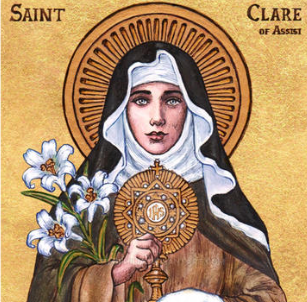
The scene is the origin of her most common artistic symbol, the monstrance or pyx.
The Siege of Assisi
A related story concerns Vitale d’Aversa, an imperial captain, who besieged Assisi around 1241. As the town trembled, Clare told her sisters to scatter ashes on their heads and to pray. The commander is said to have withdrawn. Historians note that sieges were often abandoned for strategic reasons, but the sisters and townspeople credited her prayers, and it entered the town’s collective memory.
Bread, Oil, and Healing
Clare’s biographers record several smaller wonders. When the sisters ran out of bread, Clare is said to have blessed what remained and found it multiplied. Another story says an empty oil jar was found full after her prayer. In one episode, Pope Gregory IX is reported to have asked her to bless loaves of bread at a meal. She declined out of humility, but the pope commanded her in obedience, and when she made the sign of the cross, a cross appeared on each loaf.
Healing accounts are more numerous. The Legend describes how Clare cured sisters suffering from various illnesses by making the sign of the cross over them. One tale concerns a brother suffering from mental disturbance. She made the sign of the cross over him, let him sleep for a time at her feet, and he woke restored.
The Vision of Christmas Eve
The most distinctive episode occurred on Christmas Eve 1252, a few months before her death. Too ill to attend Midnight Mass at the Basilica of San Francesco, Clare lay in bed while the other sisters went. According to the witnesses, she saw and heard the entire service, including the crib and the singing, as if projected onto the wall of her room. For this reason, Pope Pius XII proclaimed her patron saint of television in 1958. It is a charmingly modern title for a medieval nun.
How Scholars Weigh the Accounts
Our knowledge of Clare’s miracles comes from two principal sources: the testimony of about twenty witnesses in the official Process of Canonization, taken under oath just after her death, and the Legend of Saint Clare, composed in the 1250s, probably by Thomas of Celano. Many witnesses were sisters who had lived with her, and their testimony has the texture of memory. Skeptical historians note that medieval miracle accounts followed literary patterns and were written to promote a cause. Believers reply that these were sworn statements from people who knew her well. Most historians treat the miracles as sincere testimony that must be read with care, while recognizing that the testimony about her ordinary life, her endurance, and her authority is strong.
Trials, Persecutions, and Controversies
Family Opposition
Clare’s earliest trial was her own family’s rage. In a culture that prized family honor, a noble daughter’s escape was a public scandal. Her kinsmen tried to compel her return, and the episode left lasting bitterness. It took years for relations to ease, and her mother’s eventual entry into San Damiano was a kind of reconciliation.
Illness and Endurance
From about the mid-1220s, Clare was frequently bedridden, and witnesses state that she endured illness for around twenty-eight years. She had also been extremely austere in her youth. Tradition says that Francis and Bishop Guido ordered her to eat a little bread each day when she was fasting, because her penances were endangering her health. Her sickness did not reduce her authority. She ran the community from her bed, received visitors, and wrote letters. Witnesses insist that she rarely complained.
The Battle with Rome
Her greatest struggle was institutional. The Church was uncomfortable with a women’s community that lived in absolute poverty. Women could not beg publicly as the friars did, and they depended on the support of men. Church leaders worried about their security and their safety. In 1219, Cardinal Ugolino wrote a Rule for the Poor Ladies based on the Benedictine model, allowing for property and stricter enclosure. Other houses adopted it. Clare did not.
In 1247, Pope Innocent IV issued another Rule that allowed corporate ownership of property. Clare, again, refused to adopt it. In her last years, she composed her own Rule, which she fought to have confirmed. It was a long contest between a determined woman and the entire Church hierarchy, and she won, though only on her deathbed. After her death, the Church gradually moved away from her ideal, and in 1263 Pope Urban IV issued a Rule that permitted property. Most Poor Clare monasteries followed it, and Clare’s own Rule was kept in only a few houses.
The Friars and the Care of Women
Another recurring tension involved the friars’ role in caring for the sisters. Clare relied on Franciscan friars for spiritual care and for gathering alms. In 1230, Gregory IX restricted the friars’ ability to visit women’s monasteries without special permission. One tradition says that Clare reacted dramatically, sending away the friars who brought food, and declaring that if the pope took away the friars who brought spiritual bread, they would not need those who brought material bread. The restriction was relaxed. Whether the story is accurate in detail or not, it shows her willingness to press her case.
Clare and Francis: A Debated Relationship
Modern writers have often wondered about the relationship between Clare and Francis. Popular novels and films sometimes present it as a romance. The evidence does not support that, and the early sources, which are generally reticent, describe a deep spiritual friendship, with Francis acting as Clare’s guide and Clare as a faithful, but also independent, follower. Francis is said to have visited her rarely, and always with a companion. When he died, his body was carried to San Damiano so that the sisters could see him one last time, and Clare and her companions are said to have wept at the grille.
A more significant question is how much Clare was simply Francis’s disciple. Earlier biographers presented her as “the little plant of Saint Francis.” Modern scholars have reassessed her as a leader and author in her own right, whose Rule, letters, and strategy show an independent mind. It is probably most accurate to say that Francis was the origin of her vocation and Clare was the architect of its institutional form.
Cloister and Critique
Some contemporary readers also raise questions about her model of enclosure. Was it empowering, giving women a space for contemplation and autonomy, or restrictive, reflecting a society that thought women needed protection from the world? Historians are divided. Defenders note that for women of the thirteenth century, the cloister was one of the few places where they could govern themselves, read, pray, and be taken seriously. Critics observe that the enclosure was often imposed by male authorities and limited women’s pastoral possibilities. Clare’s own writings suggest she saw her life not as flight from the world but as a form of service to it, through prayer.
Death, Canonization, and Posthumous Influence
The Last Days
By the summer of 1253, Clare was dying. Pope Innocent IV, who was staying in the region, visited her at San Damiano. On 9 August, he confirmed her Rule, and she received the document with joy. Two days later, on 11 August 1253, she died, surrounded by her sisters and by some of Francis’s earliest companions, including Brothers Leo, Angelo, and Juniper. She was about sixty.
Her final words, as reported by witnesses, were of trust. She is said to have turned to her own soul and told it to go forth in peace, assured of a good guide, and she thanked God for having created her. It was the ending of a woman who had spent her life learning to trust.
The Funeral
The funeral was an extraordinary event. Crowds from Assisi and the countryside gathered. Pope Innocent IV and several cardinals attended. The pope wished to celebrate the Mass of Virgins, as for a saint, rather than the Mass for the Dead, and one of the cardinals objected that it was premature. Innocent insisted. It was a sign that many people already regarded her as a saint.
The Process and Canonization
An official investigation, the Process of Canonization, began almost immediately in the autumn of 1253. It heard the testimony of twenty witnesses, including sisters, relatives, and townspeople. Pope Alexander IV canonized her on 26 September 1255 at Anagni, only two years after her death, in the papal bull Clara claris praeclara (“Clare, bright in brightness”). The wordplay on her name was too good to resist.
The Basilica and the Tomb
Her body was first buried in the church of San Giorgio in Assisi, where Francis had been laid to rest before his translation. A magnificent new church, the Basilica of Santa Chiara, was built between 1257 and 1265, its pink and white limestone and Gothic buttresses a counterpart to the basilica of Francis. Her remains were moved there in 1260. They were lost to view for centuries, and in 1850 they were rediscovered beneath the high altar. Today, they rest in the crypt of the basilica, where pilgrims can see them.
The famous crucifix that spoke to Francis at San Damiano is also kept in the Basilica of Santa Chiara, and her tunic, cord, and some other relics are on display.
A Growing Family
By the time of her death, Clare’s movement had spread to dozens of communities across Europe, from Italy to France, Spain, Germany, and Bohemia. Over time, it developed into several branches, with different rules. Reformers sought to restore her original vision. The most famous was Saint Colette of Corbie (1381–1447), who in the fifteenth century reformed numerous monasteries and restored strict poverty. The Capuchin Poor Clares and other groups followed. Today, Poor Clare monasteries exist in countries around the world.
Clare’s friend, Agnes of Prague, was canonized by Pope John Paul II in 1989, a recognition of the movement that Clare helped create.
Cultural, Artistic, and Global Impact
Symbols and Feast Day
Clare’s best-known symbol is the monstrance or pyx, recalling the defense of San Damiano. She is also shown with a lily, a lamp, and a cross, and wears the dark habit and veil of the Poor Clares. Her feast day is 11 August in the Roman calendar. For centuries it was celebrated on 12 August, the day of her burial, until the calendar reform of 1969 moved it to the date of her death. She is the patron saint of television and telecommunications, eye diseases, goldsmiths, embroiderers, and good weather, the last being a play on her name, as “clear” skies.
Art
The oldest great artwork about Clare is the altarpiece in her basilica, the Master of Saint Clare (c. 1280s), which depicts scenes from her life: her vestition, her defense of San Damiano, and her miracles. In the Upper Basilica of San Francesco, the Giotto-school fresco cycle includes a poignant scene of the sisters venerating the body of Francis at San Damiano, with Clare at its center. Later painters, including Simone Martini and many Renaissance and Baroque artists, portrayed her as a serene and radiant figure, often holding the monstrance.
Literature, Film, and Music
Clare has been a recurring presence in Franciscan literature. In film, she appears in Franco Zeffirelli’s Brother Sun, Sister Moon (1972), in Liliana Cavani’s Francesco (1989), in which Helena Bonham Carter played her, and in the 1961 film Francis of Assisi, where she was portrayed by Dolores Hart. Hart left Hollywood a few years later and became a Benedictine nun, a real-life echo of the story she had portrayed. Chiara Lubich, the founder of the Focolare movement, took the name Chiara when she became a Franciscan tertiary, and she often cited Clare as an inspiration.
Architecture and Place
Beyond Assisi’s basilica, Poor Clare monasteries and churches bearing Clare’s name stand on every continent. San Damiano itself, a small, bare-walled complex among olive trees, remains a destination for pilgrims, who can still walk its tiny cloister and see the places where she lived and died. Her name is carried by schools, hospitals, and universities. Santa Clara, California, is named for a mission dedicated to her.
Devotional Practices
The Poor Clares carry on lives of prayer, solitude, and simplicity, often with a special emphasis on adoration of the Eucharist. Many Catholics pray a novena before her feast, and some observe the Transitus of Clare, a vigil of remembrance. Pilgrims to Assisi often visit both the tomb of Francis and the tomb of Clare, as a pair, a reminder of how the two were joined in a single story.
Modern Relevance and Lessons for Today
Women and Spiritual Authority
Clare is increasingly recognized as a pioneer. She wrote her own rule, governed her own community, and negotiated with popes on her own terms. In a time when women’s voices in the Church were largely mediated by men, she asserted that a woman could discern and articulate a way of life. Whatever one thinks of the theological questions around women’s roles in the Church today, her story is an important chapter in the history of women’s leadership.
Resisting Pressure With Courtesy
Clare was tenacious, but never contemptuous. She argued with popes and cardinals while showing them respect. For anyone who has had to hold their ground against an institution, employer, or family, her example suggests that firmness and courtesy are not opposites.
Attention in a Distracted Age
Our world is saturated with images and notifications. Clare’s central practice was learning to look, to gaze deeply at something and be changed by it. Her patronage of television is a charming irony, because the discipline she taught is the opposite of scrolling: choose carefully what you let shape you. In an age of fractured attention, her call to “gaze, consider, contemplate, imitate” is a practical invitation.
Living With Chronic Illness
Clare spent nearly three decades in poor health, and she continued to serve, lead, and pray. For people who live with long-term illness, her story is not one of heroic denial but of stubborn meaning. Her sickbed was not an interruption of her mission but a place where it was lived out. She also advised moderation, urging Agnes not to damage her health, a reminder that holiness does not require self-destruction.
Simplicity and Security
Clare’s insistence on poverty was not romanticism about being poor. She saw dependence on providence as a form of freedom. In a world anxious about security, she asked a challenging question: what are we afraid of losing, and what would it mean to live with open hands? Her community survived, in part, because of the generosity of neighbors and the sisters’ own labor, not because they were rich.
Courage in a Moment of Decision
Her flight on Palm Sunday is a reminder that some choices must be made at the cost of others’ approval. It is not a call to reject family lightly. Rather, it is a recognition that integrity sometimes demands difficult decisions, made with prayer and counsel.
Solidarity Among Women
Clare’s community was a sisterhood: Ortolana, Agnes, Beatrice, and many others. They supported one another in sickness and in danger. In a culture that often pits women against each other, their example of sisterly love and shared leadership is quietly radical.
Reflection and Practical Application
1. Practice the four verbs. Choose an image, a passage of Scripture, or a work of art, and spend ten minutes doing what Clare recommended: gaze, consider, contemplate, and ask how you might imitate what you see.
2. Look at less, and look better. Identify one habit of mindless viewing or scrolling, and replace it, for one week, with something that nourishes attention: a walk, a book, a conversation, silence.
3. Hold your ground gently. The next time you must stand firm against pressure from a person or institution, aim to be both clear and respectful. Prepare what matters most, and let go of what does not.
4. Serve in small ways. Clare washed the feet of her sisters. Choose a humble task, such as cooking, cleaning, or helping a colleague, and do it without being asked or thanked.
5. Write a rule for your life. Clare spent years refining a rule. Write a short statement of the values that guide you: a few sentences about what you will protect, what you will refuse, and how you will treat people. Revisit it each month.
6. Be a friend across distance. Clare’s letters to Agnes were acts of friendship over hundreds of miles. Write a real letter, or a thoughtful message, to someone far away who would be encouraged by hearing from you.
7. Take care of your body. Clare was reminded not to fast to excess. If you are pushing yourself too hard, in work or in discipline, treat rest as part of your calling.
8. Make room for sisterhood and fellowship. Find or create a small circle of trusted people with whom you can share both struggles and hopes. Meet regularly, and be honest.
9. Embrace a season of limitation. If you are in a stretch of illness, caregiving, or constraint, ask what your situation can teach you. Clare’s sickbed became a place of prayer and counsel.
A simple weekly rhythm: on Sunday, read a short passage from Clare’s letter to Agnes (or the Gospel account of the Nativity), choose one image to hold in mind, and set aside a quiet quarter hour each evening to look at it, in prayer or simple attention.
Closing Summary
Clare of Assisi walked out of her family’s house on a spring night and spent the rest of her life inside a few small rooms, and in doing so she altered the history of the Church. She did not preach in public squares or travel to the Holy Land. She stayed put, prayed, served, and wrote. She defended her sisters with a monstrance in her hands and defended their poverty with a stubbornness that unnerved cardinals.
She was never the “little plant” of anyone. She was a founder, a teacher, and a mother to a generation of women who chose a hard and beautiful way of life. When Francis died, she was one of the first to grasp what it meant and the one who carried it forward longest. Twenty-seven years after Francis’s death, she took her last breath, thanking God for having been created. Few lives conclude so completely in gratitude.
Eight centuries later, the world has changed beyond recognition, but the questions Clare faced are familiar: What do I give my attention to? What do I fear losing? Whose voice counts, and who decides? What would it mean to live with open hands and a steady heart? Her answers, offered in small rooms and letters and a rule that took a lifetime to win, are simple and demanding. Look at what is true. Hold fast to what matters. Love the people beside you. And do not be afraid.